A video-based assessment tool, as used here, means a no-download, browser-based video editor: software that lets you create and polish a video entirely inside a browser tab. Modern versions run on WebGPU and WebCodecs, the browser standards that make this possible without a server round trip. The verdict: if you’re a creator, educator, small business, or family who wants speed and privacy without installing anything, a browser-native tool like Kudoflix is the right fit.
Key Takeaways
A browser-native video editor processes trimming, effects, and export locally in the tab, giving creators and teams faster turnaround and stronger privacy than upload-based desktop software.
| Point | Details |
|---|---|
| Definition | A no-download browser editor lets you edit and export video directly in a tab, no install required. |
| Core benefit | Speed and privacy come from local processing, with lower hardware demands than desktop software. |
| Technology enabler | WebCodecs, WASM, and WebGPU let browsers decode, render effects, and encode video without uploading files. |
| Best fit | Short-form social clips, classroom projects, and family videos suit browser editors; heavy VFX and RAW multi-cam work still favor native NLEs. |
| Try it | Kudoflix offers a free-tier browser editor with templates, auto-subtitles, and one-click social exports. |
Table of Contents
- What Is Video Based Assessment in Practice? The Benefits
- How Does Video Assessment Work Behind the Scenes?
- What Features Should a No-Download Editor Include?
- When Should You Choose a Browser Editor Over a Native App?
- How Do Teams Collaborate Without Downloading Files?
- How Do You Make Your First Video with Kudoflix?
- Why We Built Kudoflix This Way
- Ready to Edit Without the Download?
- Frequently Asked Questions
- Sources
What Is Video Based Assessment in Practice? The Benefits
Speed is the whole pitch. A browser editor skips the download, skips the install wizard, and skips the “is my laptop good enough” anxiety that comes with heavy desktop software.
- Instant access — open a tab, start editing, no waiting on a multi-gigabyte installer.
- Shareable links instead of exported files sitting on someone’s desktop.
- Lower hardware requirements, since the heavy lifting happens efficiently in-browser rather than demanding a workstation-grade GPU.
- Automated captioning and resizing for turning one video into five platform-ready versions.
There’s a real privacy upside too. Editors that process video locally in your browser don’t necessarily need to ship your footage to a remote server just to make a cut. That matters if you’re editing a family video, an internal training clip, or anything you’d rather not upload to a stranger’s cloud.
Pro Tip: Save your export settings as a template once, and reuse it every time you resize for Instagram, YouTube, and TikTok in the same session. It cuts repetitive setup down to a few clicks.

How Does Video Assessment Work Behind the Scenes?
Two architectures compete here, and understanding the difference tells you what you’re actually paying for. Server-rendered editors upload your footage to a cloud render farm, queue it, process it remotely, then send back a preview or export. Browser-native editors do the decoding, effects, and encoding right there in your tab.
The technology behind the second model is fairly new. WebCodecs handles video decoding and encoding, WebAssembly (WASM) runs near-native-speed code inside the browser, and WebGPU gives the browser direct access to your device’s graphics card for effects and rendering. Put together, these three browser APIs let editors run decoding, GPU-accelerated effects, and encoding entirely client-side, without ever uploading the raw file. WebGPU in particular is the piece that changed the math: it’s mature enough now that browser-native tools can push real GPU work to the user’s own device instead of renting server GPUs for every job.
Here’s how the trade-offs shake out:
- Server-rendered: handles heavier jobs well, but adds upload time, queueing delays, and ongoing server costs that often get passed to you as subscription price.
- Browser-native: near-instant previews, better privacy since files can stay local, and lower operating cost, but it depends on your device’s own graphics hardware.
- Hybrid setups exist too, where some browser editors act as a front-end for server-side rendering while others do the full job client-side, a distinction worth checking before you commit to a tool.
The practical result: your everyday cuts, captions, and color tweaks now happen in the same tab where you found the editor, with none of the round-trip lag that defined browser editing a few years ago.
What Features Should a No-Download Editor Include?
Not every feature in a video editor earns its place. Here’s what actually moves the needle on a quick, polished result:
- Trimming and a basic multi-track timeline — the non-negotiable core.
- Auto-subtitles, since captions now drive most social engagement and manual captioning eats hours (see Decoding AI Pronunciation Feedback Scores for speech clarity techniques).
- Audio cleanup to strip background noise without a separate audio app.
- Templates and transitions that handle pacing and style decisions for you.
- One-click resizing for vertical, square, and horizontal formats.
- Export presets for MP4 and common social specs.
- Cloud-saved projects, so you can pick up an edit from a different device.
Privacy and control matter as much as the feature list. Look for link-based sharing you can revoke, rather than a public URL anyone can stumble onto, and check whether the tool processes locally or ships your file to a server by default.
Pro Tip: If you only automate two things, make it auto-subtitles and auto-resize. Together they turn one recorded video into a week’s worth of platform-ready content without touching a second app.
Kudoflix’s feature list covers this exact set, and the documentation for its media library shows how cloud-saved projects stay organized across devices.
When Should You Choose a Browser Editor Over a Native App?
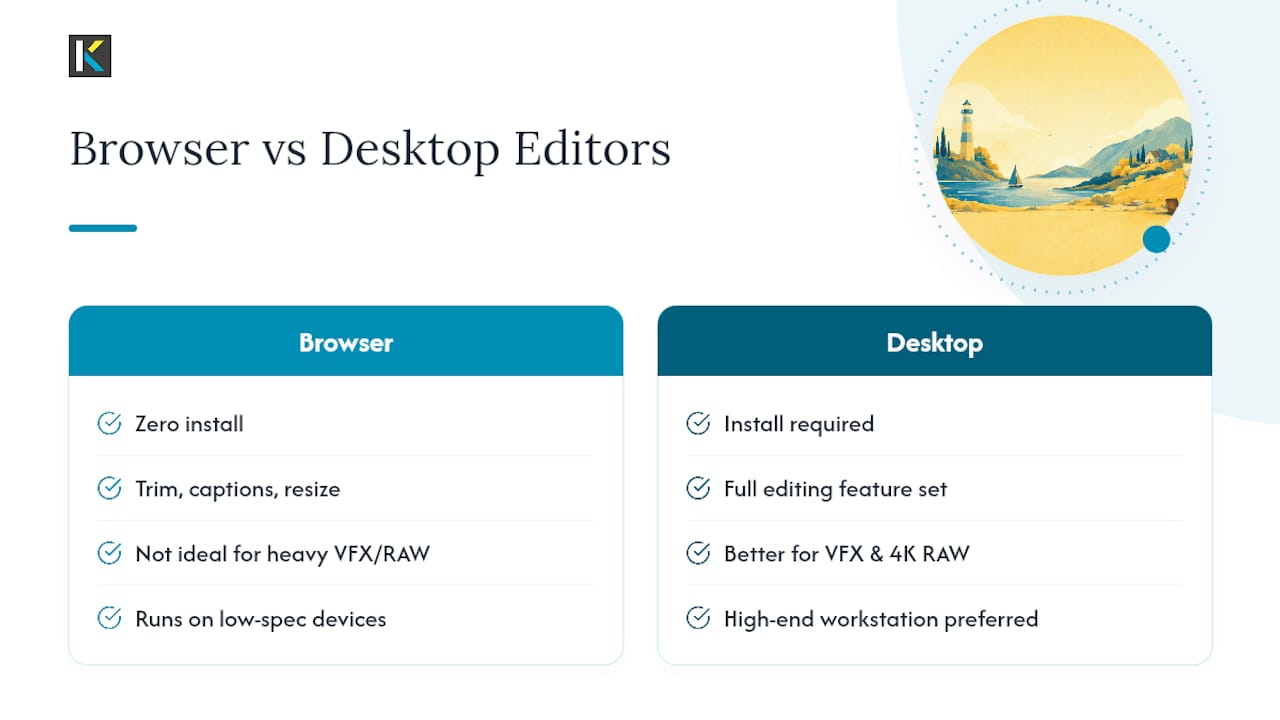
Browser editors are the right call for short-form social clips, quick training videos, family memory reels, classroom assignments, and marketing snippets that need to go out fast. These are jobs measured in minutes of footage, not hours, and speed usually beats raw editing depth.
Where they hit a wall: heavy visual effects work, multi-camera 4K RAW workflows, film-grade color grading, and anything leaning on specialized plugins. Desktop non-linear editors still hold the edge for multi-cam, RAW, and node-based color grading, while cloud workstation setups let bigger teams rent GPU-powered virtual machines instead of buying one.
The simple rule: if the project fits in a weekend and needs to move fast, use the browser. If it needs a production pipeline, look elsewhere.
How Do Teams Collaborate Without Downloading Files?
Feedback used to mean emailing a file, waiting for a download, and hoping the reviewer’s player didn’t choke on the codec. Browser-based platforms replace that with:
- Timestamped comments pinned to the exact frame someone’s reacting to.
- Version history, so nobody is guessing which cut is current.
- A shared media library everyone pulls from instead of scattered local copies.
- Role-based access that limits who can edit versus who can only comment.
A typical review cycle looks like this:
- Upload the draft or share a link.
- Reviewers leave timestamped comments directly on the timeline.
- The editor applies changes without re-uploading the whole project.
- The final cut exports and gets repurposed for other platforms.
None of this requires anyone to download a multi-gigabyte file. Cloud video editing systems combine editing software, cloud storage, and streaming preview so reviewers watch a stream instead of downloading, and that single environment cuts down the version chaos that comes from five people editing five copies of the same file.
How Do You Make Your First Video with Kudoflix?
Getting from zero to a finished clip takes about the time it takes to read this section:
- Open Kudoflix in your browser — no account setup delay, no installer.
- Drop in your media or pull from the built-in library.
- Trim your clip and apply a template to handle pacing and transitions automatically.
- Turn on auto-subtitles and audio cleanup so the rough edges disappear without manual work.
- Pick a social export preset and download or share your link.
The free tier covers the basics well enough for a casual project. Premium unlocks the wider template library, higher-resolution exports, and extra assets like advanced transitions and effects.
Callout: Choosing an export preset matters more than people think. A vertical 9:16 preset built for TikTok or Instagram Reels will crop your framing differently than a horizontal 16:9 export meant for YouTube, so pick the platform first, then let the preset handle the technical specs.
Why We Built Kudoflix This Way
We built Kudoflix because too much editing software makes people feel like they need a certification just to trim a clip. The goal was simple: remove the friction between having a good idea for a video and actually finishing it, whether that’s a school project, a product demo, or a birthday montage nobody wants to spend three hours cutting. Every feature decision traces back to that one question.
Ready to Edit Without the Download?
Traditional desktop editors ask you to download gigabytes of software before you’ve cut a single frame. Kudoflix skips that step entirely: open the browser-based editor, and you’re working with templates, transitions, auto-subtitles, and export presets in the same tab where you landed. No install queue, no “is my computer powerful enough” gamble, no license key to track down.
The free tier gets you real editing tools immediately, and premium plans open the full template library and higher-resolution exports when you’re ready. If you want to see what’s possible first, browse examples made with Kudoflix before you start your own project.
Frequently Asked Questions
What is video based assessment in the context of video editing?
Here, it refers to a browser-based video editor you use to assess, cut, and polish footage without downloading any software, running entirely in a browser tab.
How does video assessment work without installing software?
Browser APIs like WebCodecs, WASM, and WebGPU let the browser decode, process, and encode video directly on your device, avoiding the need for a separate installed application.
What are the main benefits of video assessment tools like Kudoflix?
Speed, zero-install onboarding, lower hardware requirements, automated captioning and resizing, and stronger privacy since footage can stay local rather than uploading to a server.
Are browser-based video editors good enough for professional work?
They handle everyday tasks like trimming, captions, and resizing well. Heavy VFX, multi-cam 4K RAW footage, and film-grade color grading still tend to favor a dedicated desktop NLE.
Do I need a powerful computer to use a browser video editor?
Not usually. Because processing happens efficiently through the browser’s own graphics access, these tools run well on lower-spec devices like Chromebooks, not just high-end workstations.
Sources
- The Rise of Browser-Based Video Editing: Why Creators Ditched Desktop Apps
- Cloud video editing explained — LucidLink blog
- Browser-Based Video Editing & Remote Content Production – IntelligentHQ
Recommended