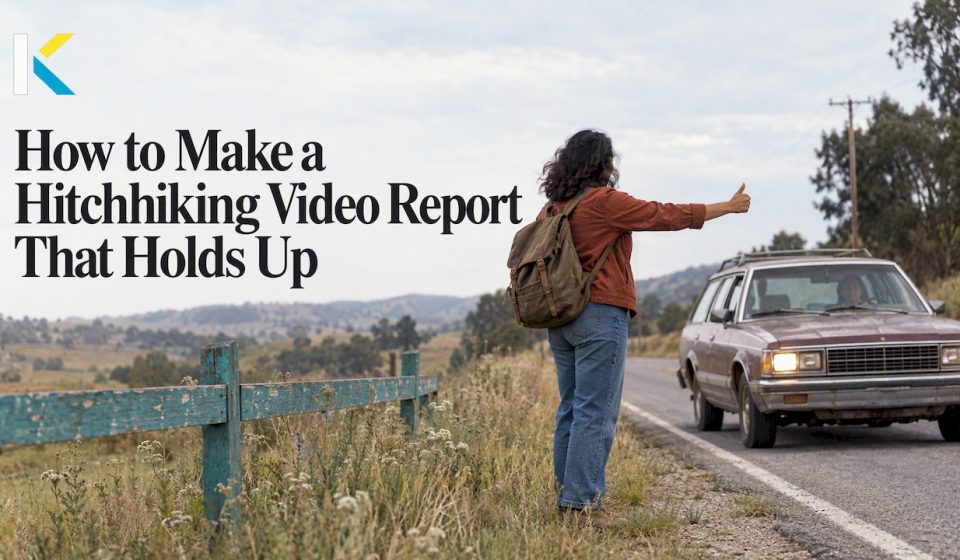

A good hitchhiking video report does three things: it tells a human story, it gets the facts right, and it never puts anyone at risk to get the footage. You can build one from archive material, interviews with people who have ridden or given rides, and a few clearly labeled facts on screen. You don’t need to stand on a highway shoulder yourself. This guide covers what to say, what to check, how to shoot safely and how to cut it all together in a browser.
Key takeaways
- Pick one angle: history, law, safety or a personal story. A five-minute report that tries all four feels thin.
- Hitchhiking is fully illegal in six U.S. states and restricted by local rules elsewhere, so never film yourself or others breaking the law for the sake of a shot.
- Separate what people remember from what the evidence shows, and say so on screen with simple labels.
- Tell the story with interviews, archive clips, maps and text cards. Staged roadside footage is optional.
- You can edit the whole thing online with no download, starting on a free plan.
Table of Contents
- What a hitchhiking video report actually is
- Choose your angle before you film anything
- The history your report can draw on
- Get the law right
- Safety facts that belong on screen
- Separate memories from evidence
- Show real people without putting anyone at risk
- Plan the structure
- Edit it online, step by step
- Our perspective
- Make your report in Kudoflix
- Common mistakes to avoid
- FAQ
- Sources
What a hitchhiking video report actually is
People searching this phrase usually want one of two things: to watch a documentary about hitchhiking, or to make a short report on it for school, a club, a travel channel or a family project. This page is for the second group.
A video report is not a vlog and not a full documentary. It runs roughly three to ten minutes, has a clear question at the center and moves between voices: a narrator, a few interviewees, some archive images and on-screen facts. Think of it as a short news feature with your own point of view.
The subject is well suited to the format. Hitchhiking has a vivid past, a contested present and plenty of personal stories. Start by agreeing on a definition your viewers will share: traveling by standing at the roadside and soliciting rides from passing vehicles. Put that sentence on screen in the first thirty seconds.
Choose your angle before you film anything
The most common mistake is trying to cover everything. Pick the question your report answers.
| Angle | Core question | Best sources | Shooting needs |
|---|---|---|---|
| History | Why did hitchhiking fade in America? | Archive footage, news articles, older relatives | Mostly archive and interviews |
| Law | What can you legally do at the roadside? | State and local rules | Text cards, maps, voice-over |
| Safety | What do the numbers and experts say? | Official studies, trail and transport bodies | Graphics and narration |
| Personal story | What was it like to ride, or to stop? | One or two interviewees | Sit-down interviews, photos |
If you are new to video, the personal story angle is the easiest to make feel real. The history angle is the easiest to research. Law and safety need the most care, because viewers may act on what you say.
The history your report can draw on
Hitchhiking in the United States has a clear arc, and each beat gives you something to show.
Wartime encouragement. During World War II, hitchhiking was actively encouraged as a patriotic way to share car resources, with government posters linking solo driving to helping the enemy. Posters make excellent opening visuals, but check the archive’s reuse terms before you place one in your video.
The highway era. On the modernized Interstate system, drivers traveled faster and pulling over became more dangerous, which made getting a ride harder. Footage of a long, fast highway needs no narration to make this point.
The image problem. Hitchhiking declined as car ownership rose, and Hollywood’s psychopathic hitchhiker trope gained traction in the 1970s and 1980s. Politics played a part too: the rise of law-and-order politics in the late 1970s contributed to hitchhikers being labeled untrustworthy or dangerous transients. A short clip from a thriller, if you have the rights, shows how the culture changed.
Still a thing? Yes, in small numbers. Travelers on long trails and in rural areas still hold out a thumb, and a new generation has rediscovered it for the connection and low-carbon appeal. Treat that as a trend to describe, not a number to quote, unless you find a figure you can cite.

Get the law right
This is the section where a careless report does real harm, so be precise and say what you don’t know.
As of June 2025, hitchhiking is fully illegal in six U.S. states. Most other states allow it as long as the hitchhiker does not stand in the roadway or obstruct traffic. Local ordinances can also ban standing in the road or hindering traffic, and the reasoning is the safety of drivers and hitchhikers alike.
Rules also differ at a smaller scale. In Pennsylvania, for example, state regulations prohibit soliciting a ride and prohibit stopping or letting a vehicle stand while hitchhikers board. In Washington, the Washington Trails Association notes that rules cover where vehicles can safely stop and where pedestrians may be, and that counties, cities or land managers may set different ones.
For your video, that means:
- Name the state or place your report covers. Never say “it’s legal in America” or “it’s illegal in America”.
- Show the rule on screen as text, with the source and the year you checked it.
- Tell viewers to confirm current rules with the state transportation department or local police before acting on anything they see.
We also keep a short checklist in our guide to a five-minute legal check before hitchhiking in the US, which is a handy companion while you research.
Safety facts that belong on screen
Safety is what most viewers want to know, and it is where hearsay thrives. Stick to documented findings and label their age.
The best-known data is old. A study by the California Highway Patrol and local law enforcement, summarized by the U.S. Office of Justice Programs, found hitchhikers were involved in an estimated 0.26% of accidents and 0.63% of crimes during its study period. Hitchhikers were victims in 71.7% of the major-crime cases involving them, and female hitchhikers were seven times more likely than males to be victims. The study is from 1974 and covers one state, so a fair report says exactly that on screen. It shows that the risk is real and uneven, not that it is the same today.
For practical guidance, use organizations that deal with this in the field:
- The Appalachian Trail Conservancy says hikers are safest arranging transportation beforehand. If hitching is unavoidable, it advises traveling with a partner, telling someone your plans, evaluating the driver and vehicle before getting in, keeping your phone, ID, wallet and pack, and recording the license plate.
- The Washington Trails Association suggests standing somewhere visible with room for a vehicle to pull out, removing hats and sunglasses, making eye contact and smiling.
- For getting home safely in general, the National Highway Traffic Safety Administration advises a pickup spot away from the roadway, never stepping into the road to flag a ride, and always wearing a seat belt.
Present these as advice from named organizations, not as your own guarantees. Never write or say “hitchhiking is safe” or “hitchhiking is deadly”. Neither is supported by the evidence above, and your report is more credible for saying so.
Separate memories from evidence
One weakness of many hitchhiking videos is that every claim comes from a single, charming storyteller. A strong report shows the viewer which kind of source they are hearing.
The PBS series Riding the Rails is a good model. It combines archival footage and newsreel interviews with the stories of people who rode the rails as teenagers in the 1930s, and the producer describes those memories as a blend of nostalgia and pain. That blend is exactly what you will hear in your own interviews.
A simple system you can apply on screen:
- Lower-third label “Remembers”: a personal account. Warm, specific, not proof of how common something was.
- Lower-third label “Record”: a document, regulation or study, with its year.
- Narrator line in between: “She remembers it as safe. The only large study we found is from 1974.”
This costs you nothing and tells viewers you respect their judgment.
Show real people without putting anyone at risk
Two quite different films show what is possible. Andrew Jones’s Thumbs Across America follows his hitchhiking trip across the country and interviews people along the way, a road-diary approach built on encounters. Riding the Rails is the archive-and-testimony approach. You can borrow from either without leaving your living room.
Interview people who have lived it. Ask older relatives, neighbors, long-distance hikers or a club member. Good questions are specific: Where were you going? Who stopped? What did you notice before you got in? Did you tell anyone? What would you do differently?
Interview the other side. Someone who has picked up riders gives you a second perspective most videos skip.
Get permission. Ask each person on camera to confirm they agree to be filmed and shared. A short spoken confirmation at the start of the take works for a family or school project. Anything commercial calls for a written release.
Don’t stage risky shots. Skip the dramatized thumb-out-on-the-highway clip unless it is on a quiet, legal, safe spot and the person is an adult who understands the situation. Reconstruct with a map animation, a title card and the interviewee’s voice over a photo.
Plan the structure
A tight five-minute structure that works for most angles:
- Hook (0:00 to 0:20). One striking image or sentence. A wartime poster, or a voice saying “I got my first ride at nineteen.”
- Question (0:20 to 0:40). State what the report will find out.
- Context (0:40 to 1:40). The short history, with archive images and a map.
- Voices (1:40 to 3:30). Two or three interview clips, each under 30 seconds, with “Remembers” labels.
- Evidence (3:30 to 4:30). Law and safety facts as text cards, each with its source and year.
- Close (4:30 to 5:00). Return to your question and answer it plainly, then show where to check the current rules.
Write the narration first, in short sentences, and record it before editing. Then place visuals over it.
Edit it online, step by step
You can finish the whole report in a browser. Here is a workflow that suits beginners.
- Collect and name your clips. Interviews, photos, scans and screenshots of documents go in one folder. Short, clear names save time later.
- Upload and rough-cut. Trim each interview to the best sentence. Merge the clips in story order on the timeline.
- Lay the narration down first. Cut your visuals to match it, not the other way around.
- Add text cards. Use one font, large type and a maximum of two lines per card. Put the source in smaller text underneath.
- Use gentle motion on photos. Slow keyframe zooms on still images make archive material feel alive without distracting.
- Pick music carefully. Use royalty-free tracks, keep them low under speech and fade them out under interviews.
- Watch it on a phone. Most viewers will.
Want more help with the basics? Our guide to beginner video editing best practices covers pacing and audio, and the page on how to turn photos and clips into a family memory film shows the same approach on a personal project. If your report leans on real footage and interviews, our documentary movie maker is built for that kind of cut.
For a more polished look, you can borrow ideas from the cinematic look shoot-to-edit guide, such as consistent color and steady framing. And if you plan to post a short version on social media, see how to adapt your edits for short and vertical formats.
Our perspective
Most of the people who come to us are not filmmakers. They are a retired couple with boxes of trip photos, a teacher building a lesson, a club recording its history. When they take on a subject like hitchhiking, the instinct is to chase dramatic footage. We think the opposite works better.
The strongest small reports we see are built on one honest voice, a handful of well-chosen images and a few facts shown plainly. The tool should vanish. That is why we built Kudoflix to run in the browser, so nothing needs installing and a slow laptop is not an obstacle. The time you save on software goes into the part that matters: asking good questions, checking your facts and deciding what not to show.
On a topic with real legal and safety stakes, restraint is a craft skill. Say what you know, date it, and send viewers to the official source.
— Mandrixx
Make your report in Kudoflix
Kudoflix is an online video editor with timelines, text and typography, transitions, color filters, keyframes and royalty-free music, all without a download. You can start on the FREE plan at $0 per month. STARTER is $9.99 per month or $83.88 per year, and PRO is $12.99 per month or $119.88 per year. See the current details on the pricing page, or open the online video editor and drop in your first interview. If you want a head start, browse the film templates for title cards and lower thirds.
Common mistakes to avoid
- Claiming a verdict. “Hitchhiking is safe” and “hitchhiking is murder” are both unsupported. Report the evidence and its limits.
- Using one old study as current fact. If it is from 1974, show 1974.
- Unlabeled reenactments. If a scene is staged, say so.
- Long text cards. Viewers can’t read and listen at once. Keep cards short.
- Loud music over interviews. The voice is the story.
- Skipping permissions. Get consent on camera, and check the reuse terms for any archive image or clip.
FAQ
How would you interpret the term hitchhiking?
It means traveling by getting free rides from passing drivers, usually strangers. A hitchhiker typically stands at a safe roadside spot, makes eye contact, smiles, extends an arm with the thumb up and may hold a sign with the destination.
Is hitchhiking still a thing in the United States?
Yes, but it is far less common than in the mid-20th century. It declined as car ownership rose, highways got faster and pop culture painted hitchhikers as threats. Some travelers, especially on long trails and in rural areas, still do it.
Why is hitchhiking illegal in some places?
Laws are generally based on the safety of drivers and hitchhikers. Hitchhiking is fully illegal in six U.S. states, and many other places ban standing in the roadway or obstructing traffic. Check your state and local rules before you film or travel.
Is hitchhiking safe?
There is limited data, and the best-known study, from California in 1974, is old. Trail and transport organizations advise traveling with a partner, telling someone your plans, checking the driver and vehicle before you get in, and avoiding impaired drivers. Arranging transportation in advance is safer still.
Do I need to hitchhike myself to make a video report?
No. Interviews, archive material, maps and on-screen facts can carry a strong report. If you do film at a roadside, stay in a legal, safe spot, never step into the road and get consent from everyone on camera.
Sources
- HITCHHIKE Definition & Meaning, Dictionary.com
- The Rise and Decline of Hitchhiking in the US, HISTORY
- Thumbs Up, Then And Now: Hitchhiking Stories From The Road, NPR
- Looking At America Through A Hitchhiking Lens, Here & Now, WBUR
- 67 Pa. Code § 601.11, Hitchhiking, Cornell Legal Information Institute
- A hitchhiker’s guide to Washington, Washington Trails Association
- California Crimes and Accidents Associated with Hitchhiking, Office of Justice Programs
- Safety & Crime Prevention, Appalachian Trail Conservancy
- Ways to Get Home Safely, NHTSA
- Thumbs Across America, Media Burn Archive
- Riding the Rails, American Experience, PBS
Recommended