Hitchhiking means soliciting a free ride from a stranger’s vehicle, usually with a raised thumb or a handwritten sign. It’s still a viable way to travel if you take real precautions: choose spots and times carefully, screen every ride before you get in, and know the law. That last part matters most, because legality shifts from state to state and even road to road.
TL;DR:
- Hitchhiking remains legal in many states when soliciting rides from shoulders or rest areas, but standing on active traffic lanes or interstate pavement is almost universally prohibited.
- Most safety data is outdated, but higher visibility, daylight hitchhiking, and rigorous ride screening significantly reduce the risk of violence or assault.
- Spot selection at gas stations, truck stops, and on-ramps improves the chances of getting longer, safer rides and minimizes the wait time.
- Online communities and apps support safe trail and rural hitchhiking, while urban hitchhiking has largely declined due to shifts toward app-based rideshare services.
- Proper preparation includes route check-ins, carrying offline maps, and having quick access to emergency contacts to respond swiftly if a ride feels unsafe or goes wrong.
Table of Contents
- What Is Hitch Hiking, and How Does a Ride Actually Happen?
- Where Is Hitchhiking Illegal in the US?
- How Risky Is Hitchhiking, Really?
- Where and When Should You Try to Get a Ride?
- Your Hitchhiking Prep Checklist: Pack, Approach, Ride, Exit
- How Do Thru-Hikers Use Hitchhiking on the Trail?
- What Do People Get Wrong About Hitchhiking?
- Why Do People Hitchhike, and Why Do Drivers Stop?
- Have Apps Replaced the Thumb?
- A Realistic Take on the Risk and the Reward
- Sources
- FAQ
What Is Hitch Hiking, and How Does a Ride Actually Happen?
Hitchhiking, sometimes called thumbing or autostopping, is the practice of flagging down passing motorists for a free ride, often with a small offer to chip in for gas as a courtesy rather than a fee. The signal is usually a raised thumb pointed in the direction of travel, though a cardboard sign naming a destination works just as well and often better.
A typical exchange is short. The hitchhiker makes eye contact, the driver slows or pulls onto the shoulder, a quick conversation through the window covers destination and comfort level, then the rider gets in. Either side can end it early with no hard feelings. Good etiquette means keeping bags out of the way, offering basic conversation without oversharing, and telling the driver clearly where you’d like to be dropped rather than assuming they’ll take you the whole way.
Where Is Hitchhiking Illegal in the US?
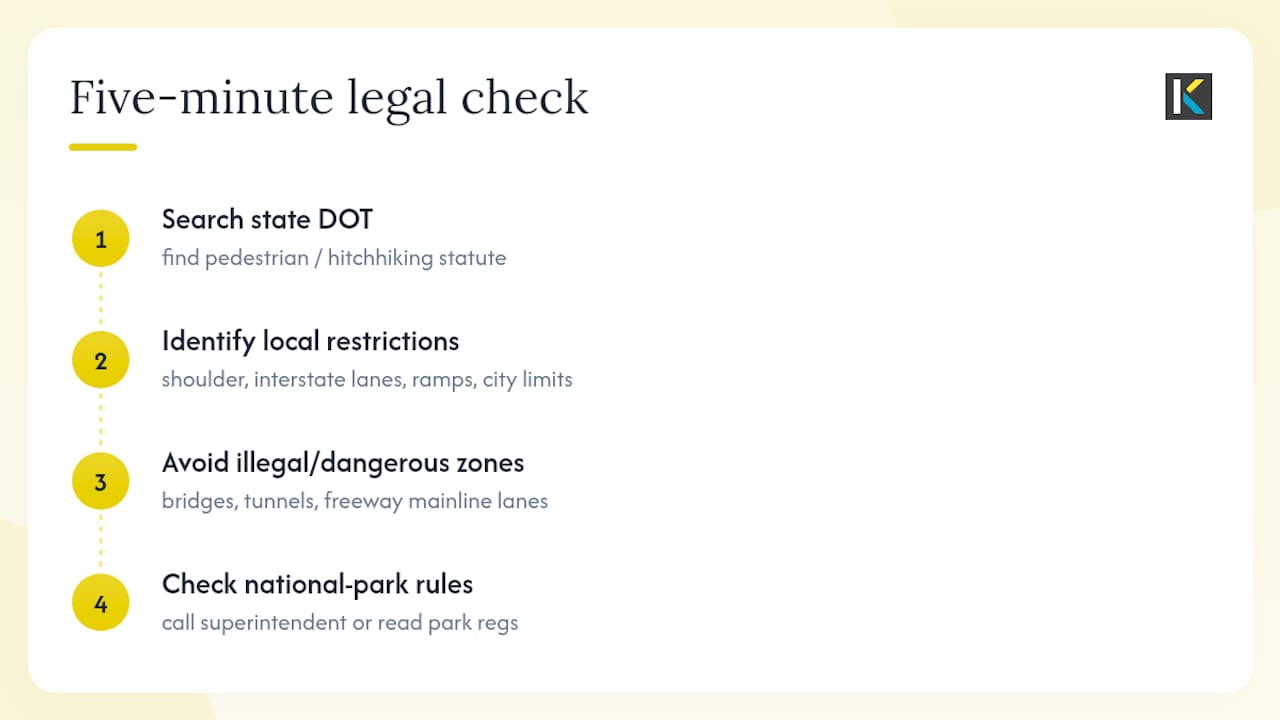
Rules vary by state, and that patchwork is the single biggest legal trap for new hitchhikers. Some states allow hitchhiking from the shoulder but ban it from the traveled roadway of an interstate; others restrict it near ramps or within city limits. The consistent thread across most state laws is that standing in an active traffic lane or soliciting rides directly on interstate pavement is prohibited almost everywhere, even where roadside hitchhiking itself is technically legal.
Generally safe, and usually legal, spots include the paved shoulder well clear of the travel lane, gas stations, rest areas, and some on-ramps where local law permits pedestrians. Bridges, tunnels, and the mainline lanes of a freeway are a different story. They’re dangerous because of blind curves and closing speeds, and they’re commonly flagged as illegal solicitation zones regardless of state.
Before you head out, spend five minutes checking. A quick search of your state’s Department of Transportation site usually turns up the pedestrian and hitchhiking statute in plain language. If you’re hitching in or near a national park, call the park superintendent’s office or check the park’s regulations page, since park rules sometimes override the surrounding state’s general traffic code. That five-minute check beats finding out from a state trooper.
How Risky Is Hitchhiking, Really?
The honest answer is that nobody has great modern data. The most frequently cited studies, a 1974 California Highway Patrol review and a 1989 German federal police study, both found that hitchhikers were not disproportionately likely to be victims of violent crime compared to other travelers. Both studies are decades old, predate cell phones and ride tracking, and used methods that wouldn’t pass muster today. Treat that finding as a starting point, not a guarantee.
What actually reduces risk is behavior, not luck. Prioritize these, in order:
- Hitch in daylight only. Nighttime hitching removes your ability to read the driver’s face, the car’s interior, and the road conditions before committing.
- Stand somewhere the driver can pull off safely, not on a curve or a narrow shoulder with no room to stop.
- Skip any car where the driver seems intoxicated, is driving erratically before they even stop, or has multiple occupants who make you uneasy for no articulable reason but your gut.
- Check the vehicle and back seat before getting in. Door handles that work, no obvious restraints or hazards, room for your bag within reach.
Before you leave the driveway, text someone your rough route and expected check-in times, and stick to that schedule. Keep your bag positioned so you can grab it and exit fast if something feels wrong.
Pro Tip: In areas without reliable cell service, a downloaded offline map plus a satellite messenger device closes the gap that phone-only travelers fall into when a ride drops you somewhere with zero bars.
Where and When Should You Try to Get a Ride?
Spot selection does more for your odds than persistence does. You want three things at once: high visibility so drivers see you early, a safe pull-off so they actually can stop, and some natural filtering for long-distance traffic so you’re not catching short-hop local drivers who’ll drop you a mile down the road.
Gas stations, truck stops, and highway on-ramps consistently outperform blind roadside spots for exactly that reason. Ride-log data compiled by Hitchwiki shows shorter median wait times for rides caught in the early morning window, generally from dawn until early morning, when commuters and long-haul drivers are both on the move and less rushed than midday traffic.
A few tactical notes worth keeping in your back pocket:
- Write your destination in large block letters on a sign. A single word, readable at highway speed, beats a paragraph nobody can parse in three seconds.
- On trail routes, add a compass direction (“NORTH”) above the town name so through-drivers can instantly tell if your route lines up with theirs.
- Skip the sunglasses. A visible face and steady eye contact make you look approachable rather than anonymous.
- Stand where you’re visible to drivers as they exit their vehicles at a pump or rest stop, not behind an obstruction, and a polite direct ask often beats passive signaling.
Your Hitchhiking Prep Checklist: Pack, Approach, Ride, Exit
Before you leave:
- Pack a small day bag with a paper map or downloaded offline map, a basic first-aid kit, ID, a portable phone charger, a reflective vest or bright top layer, and enough cash for a meal or emergency motel.
- Text a friend or family member your route, rough timeline, and check-in times.
- Check your state’s hitchhiking rules for the roads you’ll be traveling.
At the spot:
- Choose a straight stretch of road with a clear shoulder and enough sightline for drivers to see you and stop safely.
- Hold your sign at chest height, make eye contact with approaching drivers, and keep your posture relaxed and open.
- When a car stops, lean toward the window rather than the door and ask where they’re headed before you commit.
Evaluating the ride:
- Ask direct questions: destination, how far they’re going, whether they mind a stop along the way. Hesitant or evasive answers are a reason to pass.
- Decline politely and step back if the driver seems impaired, the car smells strongly of alcohol, or your gut says no. You never owe anyone a ride.
Once you’re in:
- Keep your bag within arm’s reach, not in the trunk, and stay aware of door locks and window controls.
- If something feels off mid ride, ask to be let out at the next safe, populated spot such as a gas station rather than waiting for your original destination.
If it goes wrong:
- Call or text your emergency contact immediately, and note the license plate and vehicle description the moment you’re safe.
- Move to a public, well-lit area like a store or rest stop rather than staying isolated on the roadside.
Pro Tip: Save your emergency contact’s number as a favorite before you leave. Fumbling through a contacts list is the last thing you want to do with shaking hands.
How Do Thru-Hikers Use Hitchhiking on the Trail?
For thru-hikers, hitchhiking isn’t a spontaneous adventure, it’s a logistics tool. Long-distance hikers on routes like the Appalachian Trail or Pacific Crest Trail rely on short hitches to get from a trailhead into town for resupply, laundry, and a shower, then back out again.
Trail-savvy hikers use gas stations near trailheads as natural filters, since anyone stopping there is already headed somewhere useful, and they write compass directions on cardboard signs so passing drivers can judge the route instantly. Pairing up with another hiker before sticking out a thumb also improves both safety and success rate, since two people reduce risk on both sides of the exchange. In remote sections with sparse traffic, hikers are advised to carry offline maps and a satellite messenger, and to be more conservative about which rides they accept, since a bad decision miles from cell service carries higher stakes than the same decision on a busy state highway.
What Do People Get Wrong About Hitchhiking?
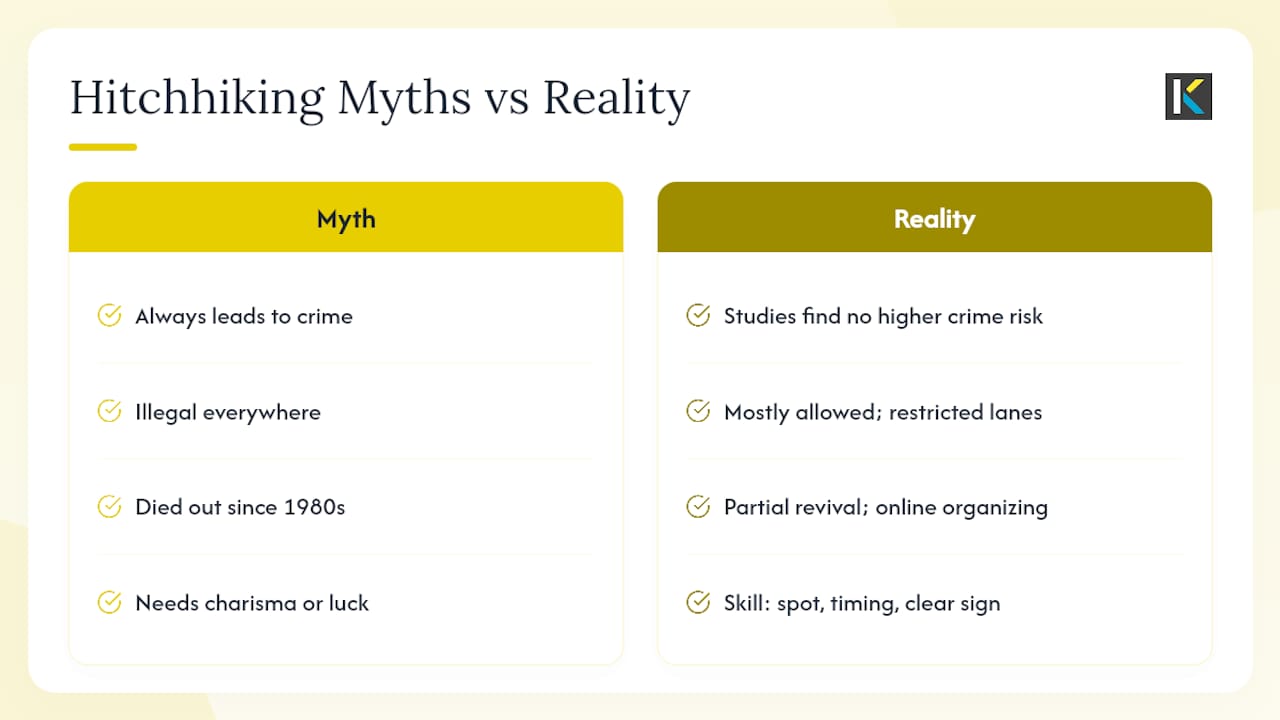
The biggest myth is that every hitchhiker ends up in a true-crime documentary. The dated but still relevant California Highway Patrol and German police studies found no disproportionate crime risk for hitchhikers, which cuts against the popular assumption that thumbing a ride is a near-guaranteed disaster. That doesn’t mean risk is zero. It means the risk profile is more nuanced than horror-movie tropes suggest, and it’s shaped heavily by the choices a hitchhiker makes about timing, location, and screening.
A second misconception: that hitchhiking is uniformly illegal everywhere in the country. In reality, most states allow it from the shoulder or at gas stations and rest areas, with restrictions aimed specifically at active traffic lanes and interstate pavement. The law is narrower and more localized than most people assume.
A third myth is that hitchhiking died out in the 1980s and never came back. Modern reporting suggests otherwise. Environmental concerns about car emissions, the cost of gas and rideshare fares, and online communities organizing around the practice have driven a partial revival, even if it never fully returned to mainstream travel habits.
Finally, people assume hitchhiking requires charisma or luck. It requires spot selection, timing, and a clear sign more than either. The practitioner tips compiled on Hitchwiki read more like a logistics manual than a personality contest.
Why Do People Hitchhike, and Why Do Drivers Stop?
Hitchhikers cite a mix of motives: it’s free, it’s low-impact environmentally, and for some it’s genuinely about the social experience of meeting strangers on their own turf rather than in a curated tour setting. For budget travelers and thru-hikers, it’s simply the fastest way to close a gap between a trailhead and a town with no other transit option.
Drivers who stop are running their own quiet calculation. Some remember hitchhiking themselves decades ago and feel a nostalgic pull to pay it forward. Others are drawn by simple curiosity about a stranger’s story, especially on long, monotonous highway stretches where company breaks up the drive. A clear, legible sign reduces a driver’s uncertainty about who they’re picking up and where that person is headed, and that reduction in ambiguity appears to be what actually triggers the decision to pull over, more than sympathy or generosity alone.
There’s also a self-selection effect worth noting. People willing to stop for a stranger on the roadside tend to skew toward those already comfortable with informal social risk, which may partly explain why the crime-rate data from those older studies came out lower than popular fear would predict. It’s not that hitchhiking is inherently safe. It’s that the pool of people who stop isn’t a random cross-section of the population.
Have Apps Replaced the Thumb?
Rideshare apps changed the default option for anyone needing a quick ride in a city, and that shift pulled a huge amount of casual, short-distance hitchhiking off the roadside entirely. Why stand in the rain waiting for a stranger when a car with your name on it shows up in six minutes?
But apps haven’t erased hitchhiking, they’ve repositioned it. Rideshare coverage thins out fast once you’re outside a metro area or past a trailhead, which is exactly where old-fashioned thumbing still has a job to do. Social media has also given hitchhiking a second life as a documented travel style rather than a desperate last resort. Creators post ride-log style content, share which routes and countries are friendliest to hitchhikers, and swap safety tips in the same spirit as the original Hitchwiki community. That online organization is a real driver behind the modest revival reporters have noticed recently, connecting hitchhikers with route intel and encouragement that used to travel only by word of mouth on the road itself.
The net effect is a split market. Casual urban hitchhiking has mostly disappeared, absorbed by app-based rides, while trail, rural, and travel-culture hitchhiking persists, now supported by better information than any previous generation of hitchhikers had access to.
A Realistic Take on the Risk and the Reward
A safety-first approach isn’t about draining the adventure out of hitchhiking, it’s about making sure you’re the one telling the story afterward. Community-maintained resources like Hitchwiki exist precisely because the people who actually hitch regularly have refined this knowledge far better than any single article can, so treat this guide as a starting point and cross-check it against current, local, on-the-ground reports before you rely on it. Prepared travelers who screen rides, check the law, and respect their own instincts get the reward part far more often than the horror-story part.
— Mandrixx
Sources
For deeper detail, Hitchwiki covers practitioner tips and ride-log timing data. Wikipedia’s hitchhiking entry covers legal variation and older safety studies. The BBC’s recent reporting and CampTrailTravel’s outdoor skills guide cover modern trends and trail use. WikiHow reinforces the stepwise how-to basics.
- Hitchhiking
- Hitchwiki: the Hitchhiker’s guide to Hitchhiking
- The lost art of hitchhiking: What we can still learn from travel’s most radical mode?
- What Is Hitch Hiking in 2026? An Outdoor Skills Guide
FAQ
Is Hitchhiking Illegal in the US?
Not uniformly. Most states permit hitchhiking from the road shoulder, gas stations, or rest areas, but nearly all restrict standing in active traffic lanes or soliciting rides directly on interstate pavement, so check your specific state’s Department of Transportation rules before you go.
Why Don’t People Hitchhike as Much Anymore?
Rideshare apps absorbed most casual, short-distance hitchhiking in cities, and decades of cultural fear around stranger danger pushed the practice to the margins, even though modern reporting points to a partial revival driven by environmental and economic motives.
How Risky Is Hitchhiking?
Dated studies from the 1974 California Highway Patrol and 1989 German federal police found hitchhikers weren’t disproportionately victims of violent crime, but the data is old and limited, so risk mitigation through daylight hitching, ride screening, and check-ins matters more than any statistic.
What Should I Do if a Ride Feels Wrong?
Ask to be let out at the next safe, public spot such as a gas station rather than waiting for your original destination, and note the license plate and text your emergency contact as soon as you’re safely out of the vehicle.