The fastest path to a completed sale is picking a selling method that matches your timeline and net-proceeds goal, then working a clear sequence: prep, price, list, show, negotiate, close. Most sellers move from decision to closing in six to ten weeks once the house is on the market, though financed buyers typically add another 30 to 45 days at the end. Get the path right first. Everything else is execution.
TL;DR:
- Listing on the MLS and pricing competitively based on recent comparables generally yields 17.5% higher net proceeds than private sales or pocket listings.
- Sellers should conduct a pre-listing inspection, handle repairs before staging, and include professional photos and videos to attract motivated buyers quickly.
- The typical sale timeline ranges from six to ten weeks for most sellers, with financed buyers adding 30 to 45 days, while cash buyers can close within two weeks.
- Choosing between an agent, FSBO, or cash offer depends on your willingness to handle marketing and negotiations, with MLS listings providing the broadest exposure.
- Properly comparing all offer components—including contingencies, earnest money, and proposed closing dates—maximizes the chances of closing at the best terms.
Table of Contents
- Steps to Sell a House: Your Timeline From Decision to Closing
- How Do You Choose Between an Agent, FSBO, and a Cash Buyer?
- How to Price Your House So It Sells Without Leaving Money on the Table
- Preparing Your Home: Repairs, Staging, and the Media Buyers Expect
- Where and When Should You List Your House?
- How Do You Evaluate Multiple Offers and Negotiate Terms?
- Inspection, Contingencies, and Closing: What to Expect
- Do Listing Videos and Virtual Tours Actually Sell Houses Faster?
- What Are the Tax Implications of Selling a Home?
- What Legal Disclosures and Paperwork Do Sellers Need?
- Should Your Strategy Change in a Buyer’s Market vs. a Seller’s Market?
- The Selling Mistakes I See Sellers Make Over and Over
- Making Your Listing Stand Out With Video
- Sources
- FAQ
Steps to Sell a House: Your Timeline From Decision to Closing
Selling a house rewards sellers who sequence their work instead of tackling it all at once. Here’s the order that actually holds up, based on the framework Redfin uses in its step-by-step selling timeline:
-
Decide to sell and pick your method. Before anything else, choose between an agent, a for-sale-by-owner (FSBO) listing, or a cash/iBuyer sale. This decision shapes every step after it, from your budget for repairs to how fast you can close.
-
Interview agents or commit to a FSBO plan. If you’re going the agent route, talk to two or three local agents in the same week so you can compare their comparative market analysis (CMA) numbers side by side. Ask for references from past clients and check how long their recent listings sat before going under contract. If you’re going FSBO, this is when you commit to a listing agreement structure, even if that agreement is just with yourself: a firm list date, a firm price ceiling and floor, and a plan for handling buyer agents.
-
Schedule a pre-listing inspection. This step gets skipped constantly, and it shouldn’t. A pre-listing inspection typically runs $300 to $500 and surfaces problems before a buyer’s inspector finds them and uses them as negotiating leverage. Finding out about a cracked sewer line yourself, on your schedule, beats finding out about it three days before closing.
-
Handle repairs, then staging, then photography, in that order. Fix the things a home inspector would flag first. Cosmetic staging comes after structural and mechanical items are handled, and professional photos come only once the house is staged and clean. Shooting photos before staging is finished is one of the more common self-inflicted wounds in a home sale.
-
Set your listing date. Late May tends to produce the strongest combination of profit and speed, and Thursday tends to outperform other days for going live, according to Zillow’s research. Weekend showings get scheduled almost immediately after a Thursday launch, which builds momentum into the first open house.
-
Go live and keep the house show-ready. Once you’re on the market, the house needs to be presentable on short notice, every day, until you’re under contract. That means beds made, counters clear, and pets managed for last-minute showing requests.
-
Field offers and compare full packages, not just price. Look at earnest money, contingencies, financing strength, and proposed closing date together.
-
Negotiate and accept. Counter on terms as often as price. A slightly lower offer with fewer contingencies frequently beats a higher one with financing risk baked in.
-
Move through inspection and appraisal contingencies. This is where deals most often wobble. Respond to repair requests quickly and decide early whether you’re offering credits or fixing items yourself.
-
Clear title and escrow. Your closing agent or attorney handles the title search and escrow process in parallel with the buyer’s financing steps.
-
Sign closing documents. Deed transfer, final settlement statement, and payoff of your existing mortgage all happen on or just before closing day.
-
Hand over keys. Closing for financed buyers usually takes 30 to 45 days from accepted offer to funding; cash buyers can close in 7 to 14 days.
Pro Tip: Print this list and pin it somewhere visible. Sellers who track their progress against a written timeline report far fewer surprises than those keeping the schedule in their heads.
How Do You Choose Between an Agent, FSBO, and a Cash Buyer?
Your selling method decision drives your timeline, your workload, and your final check amount, so it deserves more thought than most sellers give it.
Agent-assisted sales put a licensed professional in charge of pricing strategy, marketing, showings, and negotiation. You pay for that expertise through commission, but agent-listed homes tend to move through contract faster on average, and you gain access to MLS syndication and a buyer’s-agent network you can’t easily replicate alone.
FSBO (for sale by owner) cuts out the listing-agent commission entirely, which sounds appealing until you account for the time cost of marketing, scheduling showings, and negotiating without a professional buffer. FSBO works best when you already have a likely buyer lined up, or you have real market knowledge and time to spare, as industry guidance on FSBO trade-offs points out.
Cash offers and iBuyers trade a lower sale price for speed and certainty. No financing contingency, no appraisal risk, and a close date measured in days rather than weeks. This path fits sellers facing a job relocation, a probate deadline, or a house that needs more repair work than they want to finance up front.
Here’s a rough formula for estimating what actually lands in your pocket:
- Start with your expected sale price.
- Subtract your remaining mortgage payoff.
- Subtract agent commissions (if applicable).
- Subtract estimated repair costs and closing fees.
- What’s left is your net proceeds estimate.
A multi-state study found that homes listed on the MLS sold for about 17.5% more on average than homes sold through private or “pocket” listings. That gap alone often outweighs the commission you’d save going FSBO, unless you already have a qualified buyer waiting.
How to Price Your House So It Sells Without Leaving Money on the Table
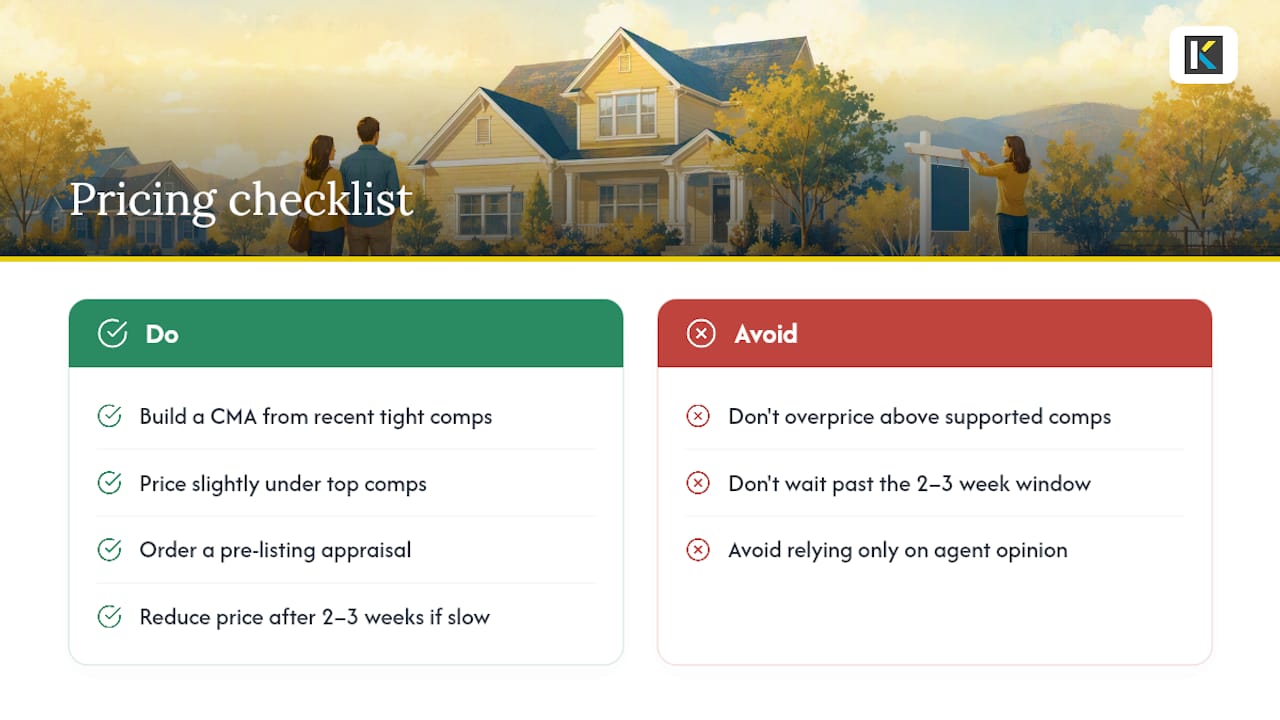
A comparative market analysis (CMA) is the backbone of a defensible list price. Agents build one by pulling comparable homes, or “comps,” that sold within roughly the last 90 days, within a tight radius of your property, matched as closely as possible on square footage, bedroom and bathroom count, lot size, and condition. The tighter that comp set, the more reliable your number.
Overpricing is the single most repeated mistake in home selling, and it’s not close. Homes priced above what local comps support get fewer showings in the critical first two weeks, and by the time the price comes down, buyers have already started to wonder what’s wrong with it. Realtor notes that overpriced listings accumulate more days on market and frequently sell for less than a home priced competitively from day one.
Two tactical moves worth considering: pricing slightly under your top comps to generate multiple showings and competing interest in the first weekend, and ordering a pre-listing appraisal so you’re negotiating from an independent number instead of just an agent’s opinion.
Pro Tip: If you haven’t gotten a serious offer within two to three weeks and showings have slowed to a trickle, that’s your signal to reduce price. Waiting past that window usually costs you more than the reduction itself.
Preparing Your Home: Repairs, Staging, and the Media Buyers Expect
Not every fix pays off. Structural, roofing, HVAC, and plumbing repairs matter because they show up on a buyer’s inspection report regardless of how the house looks. Cosmetic updates like fresh paint, updated light fixtures, and new cabinet hardware cost little and shift buyer perception fast.
Staging comes down to four moves that consistently work:
- Declutter every room, including closets buyers will open during showings.
- Neutralize bold paint colors and personal decor so buyers can picture their own belongings in the space.
- Maximize natural light by opening blinds and replacing dim bulbs.
- Create a clear focal point in each main room, whether that’s a fireplace, a window view, or a furniture arrangement.
Depersonalizing matters just as much as any paint job. Buyers need to mentally move in, and family photos and heavy personal decor make that harder, according to Realtor.com’s guidance on pre-sale prep.
Once the house is staged, invest in the media that actually gets clicks online: professional photos, a floor plan, and ideally a short walkthrough video or 3D tour. Curb appeal fixes like mulch, a fresh front door coat, and trimmed hedges cost under $200 in most cases and show up in every listing photo.
Where and When Should You List Your House?
MLS exposure isn’t optional if you want top dollar. That 17.5% price gap between MLS and pocket listings comes down to simple math: more eyes on a listing means more competing offers, and more competing offers push price up. Off-MLS or “phased” marketing can test a price point quietly, but it sacrifices the exposure that drives that premium, a trade-off Zillow’s own research on listing strategy backs up.
Timing matters more than most sellers assume. Zillow’s data on listing timing points to late May and Thursday as the combination that most often produces faster offers at higher profit, likely because weekend showings get scheduled almost immediately after a Thursday launch.
A strong listing needs professional photos, a description that leads with the home’s best feature instead of a generic room-by-room recap, and accurate facts on square footage and lot size, since MLS syndication pushes your listing to Zillow, Redfin, and dozens of other sites automatically. Paid social boosts and a well-timed open house on the first weekend add visibility on top of that baseline exposure. For sellers wanting more control over local search visibility, real estate SEO strategies can extend a listing’s reach beyond the MLS feed itself.
How Do You Evaluate Multiple Offers and Negotiate Terms?
Price is the headline number, but it’s rarely the whole story. Compare offers across every dimension:
- Offer price relative to your list price and recent comps.
- Earnest money amount, since a bigger deposit signals a more committed buyer.
- Financing contingency status, and whether the buyer has full pre-approval versus a pre-qualification letter.
- Inspection and appraisal contingencies, and how much room they leave the buyer to renegotiate later.
- Proposed closing date, and whether it lines up with your own move timeline.
A cash offer or one with minimal contingencies often beats a higher offer loaded with financing risk, because certainty of closing matters as much as the number on the page. If you get multiple strong offers, asking each buyer for their “highest and best” gives everyone a fair, final shot without a drawn-out bidding war.
Watch for red flags: a pre-approval letter from an unfamiliar lender, earnest money that’s unusually low for the price point, or inspection requests that go well beyond typical repair items.
Inspection, Contingencies, and Closing: What to Expect
After an accepted offer, the inspection period determines your next move: fix the items requested, offer a credit at closing, or hold firm and sell as-is. Financed buyers need time for both the lender’s appraisal and full loan underwriting, while cash buyers can skip both and close in under two weeks.
| Sale type | Typical time to close | Common seller costs |
|---|---|---|
| Financed buyer | 30 to 45 days | Commission, closing fees, prorated taxes, repair credits |
| Cash buyer | 7 to 14 days | Closing fees, prorated taxes, possible price discount |
On closing day, expect to sign the deed transfer, the settlement statement, and your mortgage payoff authorization. Commission typically comes off the top before you see a check.
Do Listing Videos and Virtual Tours Actually Sell Houses Faster?
Strong media doesn’t just decorate a listing, it changes buyer behavior before they ever call for a showing. A house with a walkthrough video gets more serious inquiries because buyers can rule out homes that don’t fit before wasting a showing slot, which means the buyers who do show up are more motivated.
A workable structure: a 30 to 90 second highlight reel for social sharing, paired with a longer 3 to 7 minute full walkthrough for the listing page itself. Shot list basics: exterior establishing shot, entry, kitchen, primary bedroom, and any standout feature like a view or a renovated bathroom.
- Keep clips short and steady; shaky handheld footage undercuts an otherwise great house.
- Add captions calling out square footage, lot size, and recent upgrades.
- DIY works fine for most homes under a few hundred thousand dollars; hire a professional for higher-end listings where buyer expectations are steeper.
What Are the Tax Implications of Selling a Home?
Most sellers won’t owe federal capital gains tax on the sale of a primary residence, but the exclusion has real limits. Consult IRS Tax Topic 701 for the current thresholds and eligibility rules, since they depend on how long you owned and lived in the home and whether you’ve claimed the exclusion on a prior sale within the past two years.
Gains above the exclusion threshold are taxed as capital gains, and the rate depends on your income bracket and how long you owned the property. Selling costs like agent commissions and certain closing fees typically reduce your taxable gain, which is one more reason to keep every receipt and settlement statement from the transaction.
Investment properties and second homes don’t get the same primary-residence exclusion, so if you’re selling a rental or vacation property, the tax exposure looks very different. State tax treatment varies too. Some states tax capital gains as ordinary income, others don’t tax them at all.
None of this replaces professional tax advice. A seller with a large gain, an inherited property, or a complicated ownership history should talk to a tax professional before listing, not after the sale closes.
What Legal Disclosures and Paperwork Do Sellers Need?
Every state requires some form of seller disclosure, and skipping or fudging it is one of the fastest ways to end up in a lawsuit after closing. Standard disclosure forms typically cover known material defects: roof age and condition, past water damage, foundation issues, pest history, and any unpermitted work.
Title and escrow paperwork runs in parallel with your disclosure obligations. Your title company or closing attorney searches for liens, unpaid taxes, or ownership disputes that could block a clean transfer, and escrow holds the buyer’s funds until every contingency clears.
In many states, hiring a real estate attorney is optional for a standard sale, but Bankrate’s guidance on the selling process recommends bringing one in for complex closings, unusual title issues, or FSBO deals where you don’t have an agent managing the paperwork chain. If you’re working with a lender at any point in the transaction, you can verify their license status through NMLS Consumer Access before signing anything.
Fair housing rules apply to how you market and show your home, not just how you price it, so keep listing language and showing practices neutral and consistent for every buyer.
Should Your Strategy Change in a Buyer’s Market vs. a Seller’s Market?
In a seller’s market, where inventory is tight and buyers are competing for a limited number of listings, you can price closer to or even above recent comps and expect multiple offers within the first week or two. Shorter contingency windows and escalation clauses become normal buyer tools, and you have real leverage to hold firm on price.
A buyer’s market flips that leverage. Excess inventory means buyers can shop several similar homes at once, so pricing has to be sharp from day one, and concessions like a credit toward closing costs or a home warranty often make the difference between an offer and a showing with no follow-up.
The core steps stay the same in either condition. What changes is your flexibility on price, your willingness to offer concessions, and how aggressively you market beyond the MLS. In a slower market, professional photography and video walkthroughs matter even more, since buyers are being pickier about which homes are worth an in-person visit.
The Selling Mistakes I See Sellers Make Over and Over
Overpricing tops the list, driven by emotional attachment rather than comps. Poor photos come next, usually phone shots taken before staging was finished. Skipping the pre-listing inspection is the third repeat offender, and it almost always costs more in last-minute negotiating than the inspection itself would have.
The fix for all three is the same discipline: get a real CMA, stage before you shoot, and inspect before you list. Then verify anything state-specific, disclosure rules, transfer taxes, attorney requirements, with a local professional before you sign.
— Mandrixx
Making Your Listing Stand Out With Video
Photos get a buyer to click. Video gets them to book a showing before they’ve even seen the house in person, and that’s the gap most FSBO sellers and smaller brokerages leave on the table because hiring a videographer feels expensive and slow.
This video editing platform closes that gap without the wait. It is a browser-based video editor with no download required, built around templates specifically designed for property walkthroughs, room highlight reels, and short social clips. You upload your phone footage or photos, drop them into a real estate-focused template, and add captions calling out square footage or recent upgrades, all without learning traditional editing software.
It fits sellers doing their own marketing, brokers producing listing media at volume, and anyone who wants a polished walkthrough ready before the weekend’s first showings. Start with a free video template and have your highlight reel ready before your next open house.
Sources
FAQ
What should you do first when selling a house?
Decide on your selling method (agent, FSBO, or cash buyer) before anything else, since that choice determines your timeline, budget, and how much prep work falls on you.
What is the hardest part of selling a house?
Most sellers struggle most with pricing objectively and with the inspection negotiation period, where repair requests and credit demands can stall or derail a deal.
What is the most profitable way to sell a house?
Listing on the MLS with a competitive, comp-based price typically nets the most money. MLS-listed homes sold for about 17.5% more than off-MLS pocket listings in one multi-state study.
How long does it take to sell a house after listing?
Expect several weeks to reach a signed contract, then another 30 to 45 days to close with a financed buyer, or as little as 7 to 14 days with a cash buyer.
Do I need a lawyer to sell my house?
In most states it’s optional, but a real estate attorney is worth hiring for complex closings, unusual title issues, or FSBO sales without an agent managing the paperwork.
Recommended