Sell privately if you want the most cash and have a few weeks to work with. Sell to an instant online buyer like Carvana or CarMax if you need the money fast and want a low-risk, hands-off transaction. Trade it in at a dealership if convenience matters more than price and you’re already buying another car. Private sales typically net more money but take longer and require more effort; instant offers pay less but close in days.
TL;DR:
- Private sales typically net 10 to 20 percent more than instant offers but require more effort and longer time to complete.
- Instant online buyers like Carvana and CarMax offer fast quotes within minutes and close deals within one to three days, with minimal effort.
- Trade-ins are the most convenient, often finalizing within days, but usually result in the lowest payout compared to private sales or instant offers.
- Preparing necessary paperwork, including the title, registration, bill of sale, and maintenance records, is crucial to avoid delays and legal issues during the sale.
- Checking instant offer prices beforehand provides a clear fallback and negotiation leverage, especially when time or convenience is a priority.
Table of Contents
- How Do I Sell a Car: Comparing Private Sale, Trade-In, and Instant Offers
- Which Selling Path Actually Fits Your Situation?
- What Documents Do You Need to Sell a Car?
- How Do You Price a Car for Sale?
- How Do You Prepare a Car for Sale and Take Photos That Sell?
- How Do You Screen Buyers and Close a Private Sale Safely?
- What Happens When You Sell to a Dealer or Instant Offer Service?
- How Do You Avoid Scams When Selling a Car Privately?
- How Do You Finalize the Title Transfer and Paperwork?
- What Should You Do After Selling Your Car?
- Trade-In vs. Private Sale: Which One Actually Serves You Better?
- Do State Laws Affect How You Sell a Car?
- How Do You Negotiate With Buyers Without Losing the Deal?
- What I’ve Learned Helping Sellers Get This Right
- Make Your Listing Stand Out With a Short Video
- Sources
- FAQ
How Do I Sell a Car: Comparing Private Sale, Trade-In, and Instant Offers
Each path trades speed for money, or money for convenience. Private sale wins on price. Menthemdrive’s market breakdown puts the private-sale premium at 10 to 20 percent above what instant-offer platforms typically pay, but that gap comes with real work: screening buyers, hosting test drives, and handling your own paperwork.
Trade-ins are the most convenient option, folding the transaction into your new-car purchase. While often less profitable, in some states the tax treatment can partially reduce the effective price gap.
Instant online buyers land in the middle. Kelley Blue Book’s Instant Cash Offer program and services from Carvana and CarMax generate a quote in minutes, verify it with an in-person or virtual inspection, and typically cut a check within a day or two once you accept.
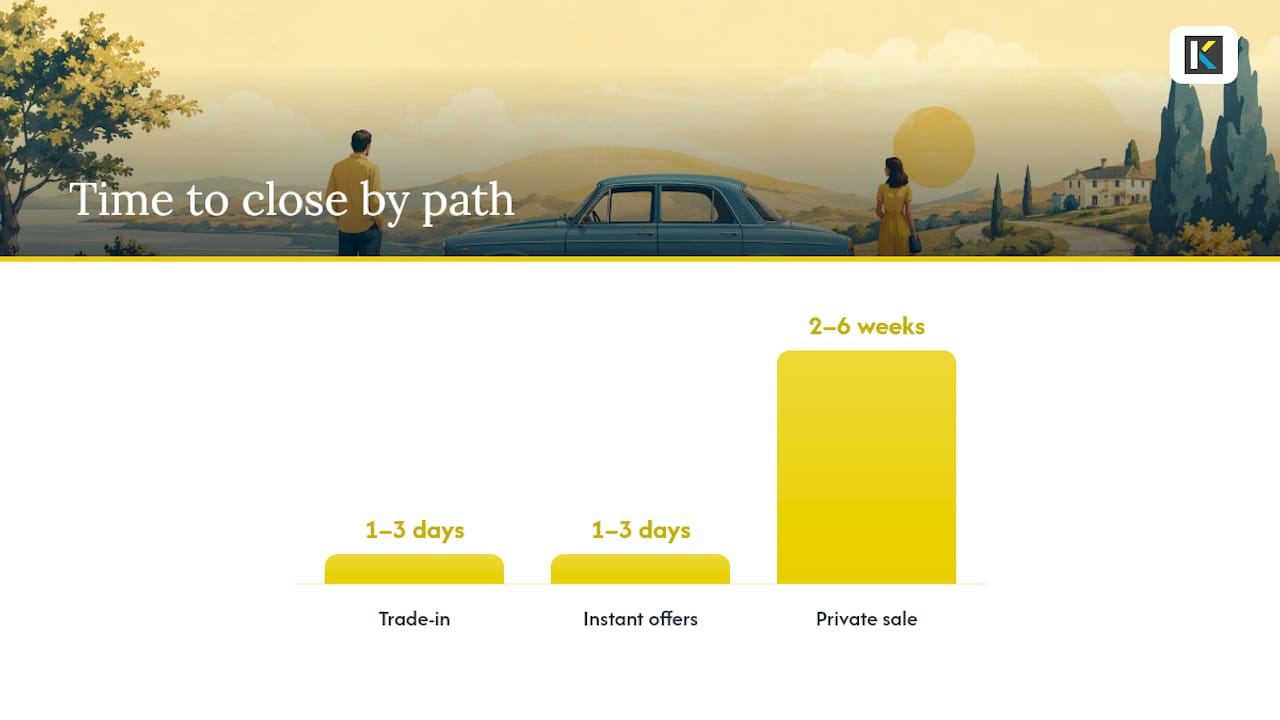
- Speed: Trade-in and instant offers close in 1 to 3 days; private sales often take 2 to 6 weeks.
- Net price: Private sale usually highest; trade-in usually lowest; instant offers land in between.
- Convenience: Trade-in requires almost no effort; private sale requires the most.
- Risk: Private sale carries scam and no-show risk; dealer and instant-offer channels carry almost none.
- Timeframe to complete: Trade-in and instant offers finish quickly, often within days; private sales conclude once a serious buyer is found.
Cars.com and similar marketplaces let you request a guaranteed instant offer alongside a private listing, so you’re not locked into one lane while you test the market.
Which Selling Path Actually Fits Your Situation?
Match the channel to your priorities before you list anything. Use this order to decide:
- Set your timeline. If you need the car sold this week, skip private sale entirely and go straight to instant offers.
- Decide what “good enough” money looks like. If you’d walk away from an extra $500 to save three weeks of showing the car, trade-in or instant offer is your answer.
- Check the car’s condition honestly. High-mileage or mechanically rough vehicles tend to net closer to instant-offer pricing anyway, since private buyers negotiate hard on flaws.
- Confirm your loan payoff amount. If you owe more than the car is worth, a dealer trade-in can fold the shortfall into your next loan more easily than a private sale can.
- Get instant offers from two or three platforms first. Treat the highest one as your floor. If private buyers won’t beat it within a week or two, take the offer.
- Weigh the trade-in tax angle only if you’re buying another car. In states with trade-in tax credits, the effective savings can shrink or erase the price gap.
Running this checklist takes two or three minutes and saves you from committing to a slow private sale when your actual priority is convenience, or from taking a lowball trade-in offer when you had time to sell privately all along.
What Documents Do You Need to Sell a Car?
Missing paperwork is the single most common reason private sales stall at the finish line. Gather these before you list the car, not after a buyer shows up ready to pay.
- The title. If you own the car outright, this is non-negotiable. If you’re still financing it, contact your lender for the payoff amount and their process for releasing the title.
- Current registration, which most buyers and DMVs want to see alongside the title.
- A bill of sale listing the sale price, date, VIN, odometer reading, and both parties’ signatures and printed names.
- Maintenance and service records, especially receipts for major work like brakes, tires, or a transmission service.
- The owner’s manual, both key fobs, and any spare keys.
- A release of liability or notice of transfer, filed with your state DMV after the sale, which protects you from tickets or liability tied to the car after it changes hands.
Special cases add steps. If the title lists two owners, both signatures are usually required unless the title reads “or” instead of “and.” Leased vehicles route through the leasing company, not you, since they hold the title. Out-of-state titles sometimes need a state-specific transfer form. Edmunds’s step-by-step seller guide walks through DMV paperwork requirements in more detail, and it’s worth a look if your state has unusual rules.
How Do You Price a Car for Sale?
Pull numbers from at least three sources before you settle on an asking price, because relying on one tool almost always skews high or low. Start with Kelley Blue Book’s private-party value and cross-check it against Edmunds’ True Market Value, since the two use different data pools and rarely agree exactly. Then scan Cars.com and Facebook Marketplace for comparable vehicles in your area, matching year, trim, and mileage as closely as possible.
- Pull KBB private-party value and Edmunds TMV for your exact trim and mileage.
- Search local listings for the same year and model within 50 miles.
- Adjust up or down based on condition, accident history, and any recent major repairs.
- Request an instant offer from Carvana or CarMax to establish a hard floor price.
- Set three numbers: an asking price with room to negotiate, a realistic target price, and a walk-away minimum you won’t go below.
Pro Tip: Price your car about 5 to 10 percent above your target number. Almost every private buyer will negotiate, and starting high gives you room to “come down” without actually losing money.
That instant offer does double duty. It’s a guaranteed fallback if private sale drags on, and it’s leverage: telling a hesitant buyer “I already have a cash offer at this price” often moves negotiations faster than any pitch about your car’s condition.
How Do You Prepare a Car for Sale and Take Photos That Sell?
Buyers decide whether to click on your listing within seconds, and that decision rides almost entirely on your photos and headline. Detailing comes first: wash and wax the exterior, shampoo the carpets, wipe down every interior surface, and fix small things like a burned-out taillight bulb or a cracked wiper blade. These are cheap fixes that remove easy objections.
- Clean everything, inside and out, including the trunk and under the seats.
- Shoot 15 to 20 photos: front and rear three-quarter angles, both sides, full interior, dashboard with mileage visible, engine bay, and any existing damage shown honestly.
- Shoot in daylight, ideally an overcast morning, since harsh sun creates glare that hides detail.
- Write a title line with year, make, model, trim, and mileage.
- Add a one-line summary highlighting your best selling point, whether that’s low mileage, one owner, or a fresh set of tires.
- List maintenance highlights and disclosures together, so buyers see the good and the bad in the same paragraph.
- State accepted payment terms clearly (cash, cashier’s check, verified bank transfer).
- Cross-list on Cars.com, Facebook Marketplace, and Craigslist to widen your buyer pool without extra cost.
Detailed photos paired with dated service receipts build trust fast, and listings with that combination tend to spend noticeably less time sitting unsold.
How Do You Screen Buyers and Close a Private Sale Safely?
Screening starts the moment someone messages you. Ask what they’ll use the car for, whether they’ve secured financing, and when they want to see it. Vague or rushed answers are a red flag worth noting.
- Screen every inquiry by phone before agreeing to a meeting.
- Meet at a public location, ideally a bank or busy parking lot, never your home.
- Photograph the buyer’s driver’s license before handing over the keys for a test drive.
- Bring a friend along for test drives whenever possible.
- Accept only verified funds: a bank wire you’ve confirmed as received, or a cashier’s check verified in person at the issuing bank.
- Never accept a personal check or a check for more than the agreed price.
- Finish with a signed bill of sale, accurate odometer reading, and immediate title transfer.
Travelers Insurance recommends keeping your policy active through the entire sale process, since a lapsed policy leaves you uninsured during test drives with strangers behind the wheel.
What Happens When You Sell to a Dealer or Instant Offer Service?
Instant-offer platforms generate a quote from your VIN, mileage, and condition answers, then verify it with an inspection, either in person or over video. Consumer Reports notes that most offers stay valid for a set window, often 7 days, giving you time to compare against private-sale interest before committing.
- Disclose every issue upfront: accidents, warning lights, worn tires. Surprises found during inspection are the top reason offers get lowered.
- Expect adjustments for tire wear, windshield damage, or mismatched mileage from what you reported online.
- If trading in at a dealership while buying another car, negotiate the new car’s price first, completely separate from the trade-in number, so the dealer can’t blur the two to hide a weak trade offer.
- Ask the dealer or platform how they handle an existing loan payoff. Reputable buyers pay your lender directly and send you the difference.
How Do You Avoid Scams When Selling a Car Privately?
Private sales attract more scams than any other channel, and most follow a predictable script. Watch for buyers who overpay and ask for a refund of the difference, fake cashier’s checks that clear temporarily before bouncing days later, and “escrow services” that are really just a scammer’s payment portal.
- Never ship a car before payment fully clears your account, no matter how convincing the buyer’s story is.
- Verify a cashier’s check in person at the issuing bank before handing over keys or a title.
- Be suspicious of any buyer who wants to pay more than your asking price and get cash back.
- If using escrow, confirm the service is real and established. Scammers frequently build fake escrow sites for exactly this purpose.
- Watch for buyers claiming to be out of the country or in the military who “can’t meet in person.”
The FTC’s consumer guidance covers general protections that apply to both buyers and sellers during vehicle transactions.
Pro Tip: If a deal feels rushed or a buyer avoids meeting in person, walk away. Scammers rely on urgency to skip the verification steps that would expose them.
How Do You Finalize the Title Transfer and Paperwork?
Closing the deal correctly protects you from liability long after the car leaves your driveway. Sign the title exactly as instructed by your state, filling in the sale date, price, odometer reading, and the buyer’s name and address.
- Complete the bill of sale with both signatures, the VIN, sale price, and date.
- Record the odometer reading on the title itself, since most states legally require this disclosure.
- File a release of liability or notice of transfer with your state DMV within the required window, often 5 to 10 days, so any future tickets or accidents aren’t traced back to you.
- Cancel or transfer your insurance policy only after the sale is final and the title has changed hands.
- If you had a loan, confirm the payoff amount was received and ask when the lender will mail the released title to the new owner.
Skipping the release of liability is the single most common mistake sellers make, and it’s the one most likely to land a stranger’s parking ticket in your mailbox months later.
What Should You Do After Selling Your Car?
The paperwork trail matters even after the money clears. Keep copies of every signed document, the bill of sale, and proof of payment somewhere safe for tax purposes and in case a dispute arises later.
- Keep signed copies of the title, bill of sale, and release of liability for your own records.
- Confirm the buyer actually registered the vehicle in their name if your state allows you to check.
- Watch your mail and email for DMV notices or toll violations tied to the car for a few months after the sale.
- Cancel any subscriptions tied to the vehicle, like satellite radio or a connected-car app, and remove automatic payments.
Trade-In vs. Private Sale: Which One Actually Serves You Better?
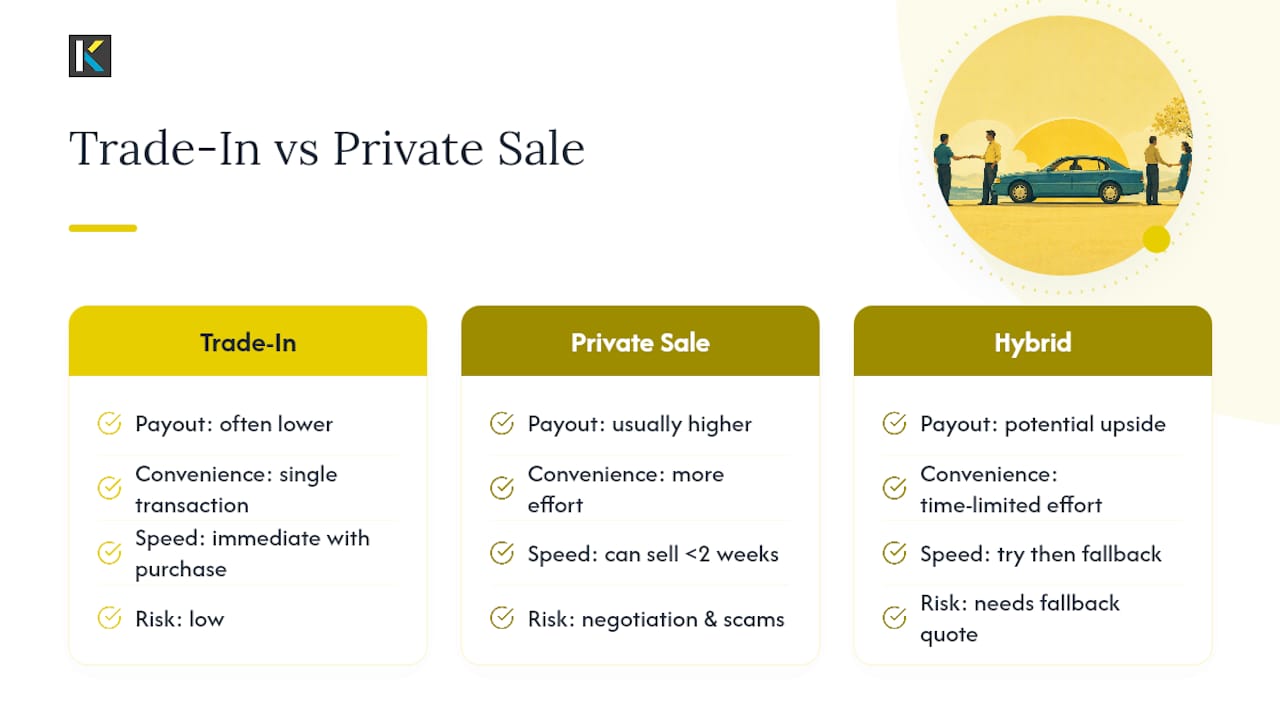
The math looks simple on paper, private sale nets more money, but the real comparison depends on what your time is worth and what you’re doing with the car afterward. A trade-in folds directly into a new purchase, meaning you drive away in one transaction instead of juggling two — see how specialized Auto Dealer SEO Services help dealers showcase inventory and sell more cars. That single trip is worth real money to someone with a demanding schedule or a car that needs to disappear quickly.
Private sale wins when you have flexibility. Selling to an individual buyer means no dealer markup gets subtracted from your payout, and in a strong local market, a well-priced listing with clean photos can move in under two weeks. The tradeoff is direct exposure to buyer negotiation, no-shows, and the small but real scam risk private sellers accept that dealers simply don’t.
There’s a middle case worth naming: some sellers try private sale for two or three weeks with a firm deadline, then pivot to a trade-in or instant offer if no serious buyer materializes. This hybrid approach captures upside without an open-ended commitment. It only works if you’ve already gotten an instant-offer quote as a fallback, so you’re never negotiating from a position of “I have to sell this to someone, right now.”
Condition matters here too. Cars with mechanical issues or high mileage tend to see a smaller gap between private-sale and trade-in pricing, since private buyers discount hard for visible flaws anyway. In that case, the convenience of a trade-in starts to look like the smarter trade.
Do State Laws Affect How You Sell a Car?
Rules vary enough by state that assuming your neighbor’s process applies to you is a mistake. Emissions testing requirements, smog certificates, and safety inspections are handled entirely at the state level, and some states require the seller to provide a current inspection certificate before the sale can legally close, while others place that burden on the buyer after registration.
Disclosure laws also differ. Every state requires accurate odometer disclosure on the title, a federal requirement enforced through state DMV processes, but some states go further and mandate written disclosure of known frame damage, flood history, or airbag deployment. Selling a car you know has an undisclosed safety issue can expose you to legal liability well after the sale closes, regardless of what your state’s specific disclosure form requires.
Titling procedures aren’t uniform either. Some states require a notarized signature on the title transfer; others don’t. A handful of states require both buyer and seller to appear together at the DMV, while most allow the buyer to complete registration independently once they have a signed title and bill of sale.
Because these rules shift by state and change periodically, check your state DMV’s website directly before listing your car, especially if you’re selling across state lines or the vehicle has any history worth disclosing. Skipping this step is how sellers end up with a stalled sale or an unexpected liability months later.
How Do You Negotiate With Buyers Without Losing the Deal?
Price anchors the negotiation, but how you handle the back and forth determines whether you land near your target or well below it. Start by listing slightly above your target price, which gives buyers room to feel like they’ve won something without actually costing you money.
Let the buyer make the first offer once they’ve seen the car in person. Sellers who blurt out a lower number to “keep things moving” routinely leave money on the table that a patient buyer would have paid anyway. If an offer comes in low, respond with a specific counter tied to something concrete, recent maintenance, low mileage, a clean title, rather than just repeating your asking price.
Silence is a legitimate tool. After stating your counter, let it sit instead of immediately negotiating against yourself. Buyers often fill that silence with a better offer than you expected.
Keep your instant-offer quote in your back pocket, not on the table from the first message. Revealing it too early gives buyers a ceiling to negotiate down from. Save it for the moment a buyer stalls or lowballs you, then mention it as proof you have a real, guaranteed alternative.
Walk away from buyers who ask you to skip a bill of sale or rush the title transfer to “save time.” That request usually signals either a scam or a buyer who’ll cause problems later, and no discount is worth that risk.
What I’ve Learned Helping Sellers Get This Right
The single most effective move in this entire process is getting instant offers before you do anything else. It costs nothing, takes ten minutes, and gives you a real number to measure every other offer against instead of guessing. Selling a car always comes down to trading time for money. Decide which one you have more of, then pick your channel accordingly.
— Mandrixx
Make Your Listing Stand Out With a Short Video
A 30 to 60 second walk-around clip does something photos can’t: it shows the engine running, the doors closing properly, and the interior in motion, all the details a skeptical buyer wants to see before agreeing to a test drive. Listings with video tend to draw more serious inquiries and fewer time-wasting questions, simply because buyers arrive already convinced the car looks and sounds the way you described it.
There are online video editors that make that clip painless to produce with no software to download, no rendering delays on your laptop, just a browser-based editor with automotive-friendly templates, quick trims, and text overlays for pointing out mileage or recent maintenance. Shoot the footage on your phone, drop it into Kudoflix’s online video editor, add a template, and export it in minutes, ready to attach directly to your Cars.com or Facebook Marketplace listing. If you’re picturing hours of fiddling with clunky desktop software, that’s exactly the friction Kudoflix was built to remove. Try it free on your next listing and see if a 45 second video gets you more serious replies than photos alone.
Sources
- Sell My Car – Kelley Blue Book
- How to Sell Your Car to an Online Retailer
- How to Sell a Car (Edmunds)
FAQ
What Is the $3,000 Rule for Cars?
There’s no official “$3,000 rule” from any government agency or major valuation service; it’s an informal budgeting guideline some buyers use for setting a low-end price ceiling on used cars, not a rule that affects how you should sell your own vehicle.
What Is the Best Way to Sell My Car?
The best method depends on your priority: private sale nets the most cash, an instant offer from a service like Carvana or CarMax is fastest and lowest-risk, and a dealer trade-in is most convenient if you’re buying another car.
How Do I Protect Myself When Selling a Car?
Meet buyers in public places, verify any cashier’s check in person at the issuing bank, never accept a personal check, and keep your insurance active through the entire sale process.
What Documents Do I Need to Sell a Car Privately?
You need the signed title, current registration, a bill of sale with the VIN and odometer reading, and a release of liability filed with your state DMV after the sale closes.
How Long Does It Take to Sell a Car?
Instant offers and dealer trade-ins typically close within a day or two, while private sales usually take two to six weeks depending on pricing, condition, and local demand.
Recommended