“Baby Shark Dance” from Pinkfong holds the top view count on YouTube, past 17 billion as of mid-2026, with “Despacito” and “See You Again” close behind. But raw views and genuine virality aren’t the same thing: a nursery-rhyme video gets replayed thousands of times by the same toddlers, while a clip like “Charlie Bit My Finger” spread because millions of strangers saw it once and had to share it. Both matter. They just measure completely different things.
TL;DR:
- Children’s content like Baby Shark and Cocomelon dominates the all-time view counts through high repeat viewing rather than broad audience reach.
- Modern algorithms heavily favor videos that are repeatedly watched within households, boosting their visibility through optimized recommendation systems.
- The most viewed videos tend to fall into four genres: music, children’s content, movie trailers, and novelty clips, each winning through different mechanisms like reach or shareability.
- YouTube rewards longevity, with views accumulating over years, whereas TikTok emphasizes quick, peak-week popularity with shorter-lived viral hits.
- Viral success now varies greatly by platform and regional preferences, making cross-platform comparisons or universal viral metrics misleading.
Table of Contents
- Most Viral Videos of All Time: The Full Ranked List
- How the Leaderboard Changed Over Time
- What Actually Drives Massive View Counts
- The Content Categories That Dominate All-Time Totals
- The Classic Viral Hits Everyone Remembers
- How Social Media Platforms Reshaped What Goes Viral
- Case Studies: How These Specific Videos Actually Broke Through
- Comparing Virality Across YouTube, TikTok, and Facebook
- Why Culture and Region Shape What Goes Viral
- What Creators Should Actually Take From This
- Sources
Most Viral Videos of All Time: The Full Ranked List
The videos with the most total views on YouTube skew heavily toward two categories: music videos with global label promotion, and children’s content built for endless replay. Here’s how the leaderboard actually breaks down, drawing on the tracking maintained by Wikipedia’s list of most-viewed YouTube videos.
- Baby Shark Dance (Pinkfong) — The reigning champion with the highest view count. A three-minute nursery song outpaces every music superstar on the platform because toddlers don’t skip.
- Despacito (Luis Fonsi ft. Daddy Yankee) — A highly viewed video, notable as the first to hit 5 billion and briefly the most-viewed video on Earth before “Baby Shark” overtook it.
- See You Again (Wiz Khalifa ft. Charlie Puth) — A popular tribute video released after Paul Walker’s death, giving it emotional weight that kept people replaying and resharing it for years.
- Shape of You (Ed Sheeran) — One of the few pop songs from a solo Western artist to crack the very top tier in views.
- Uptown Funk (Mark Ronson ft. Bruno Mars) — A radio-friendly hit that translated into one of the stickiest music videos of the 2010s.
- Wheels on the Bus (Cocomelon) — A children’s video demonstrating high repeat viewing similar to Baby Shark.
- Gangnam Style (PSY) — A landmark video that broke YouTube’s original counter in 2014, forcing an engineering fix due to unexpectedly large view counts.
- Johny Yes Papa (LooLoo Kids) — A children’s channel that built one of the biggest libraries in YouTube history with very high view counts.
- Sugar (Maroon 5) — Notable for its flash-mob wedding concept, attracting millions of views over years after release.
- Roar (Katy Perry) — Part of the wave of mid-2010s pop videos that helped establish the billion-view benchmark as routine.
Below the top ten, the pattern repeats: Ed Sheeran’s “Thinking Out Loud,” Wiz Khalifa’s other hits, Bruno Mars tracks, and additional Cocomelon and Pinkfong uploads fill out the next fifteen slots. Genre-wise, music videos dominate numerically since 2010, and industry tracking from QZ confirms that trend has only strengthened as labels treat YouTube as a primary release platform rather than a secondary one.
What’s striking is the near-total absence of the clips most people associate with the word “viral.” “Charlie Bit My Finger,” “Gangnam Style” aside, “Chocolate Rain,” and “Rickroll” don’t appear anywhere near this list. They mattered culturally in a way raw numbers never captured, which is exactly the distinction this article keeps coming back to.
The Billion-View Club, the informal term for any video that crosses that threshold, now numbers in the hundreds. When “Gangnam Style” joined in 2012, it was one of one. That scarcity is gone, but the club’s composition tells its own story: overwhelmingly music and kids’ content, almost nothing amateur, almost nothing that started as a genuine internet accident.
How the Leaderboard Changed Over Time
The billion-view milestone didn’t exist for YouTube’s first seven years. Understanding when it arrived, and what got knocked out along the way, explains a lot about how “viral” evolved from an accident into an industry strategy.
The Gangnam Style engineering fix is worth pausing on. YouTube’s original counter simply wasn’t built to handle a number that big, because nobody at the company thought a single video could get there. That’s a very different problem than the platform faces today, when Baby Shark’s climb toward 20 billion is treated as expected.
The Charlie Bit My Finger takedown is the more instructive story for anyone trying to compare historic counts directly. The family briefly pulled the original video in 2020 and sold it as an NFT before restoring public access. That gap means any “all-time views” comparison involving the video has to account for lost time, and it’s a reminder that legacy counts aren’t as stable as they look. Researchers and trackers generally cross-check numbers like this against archived snapshots rather than trusting a single live count, exactly because removals and reuploads happen more often than casual readers assume.
What Actually Drives Massive View Counts
Two forces explain almost every entry near the top of the leaderboard, and neither one is “the video was funny” or “people loved it.” It’s repeat viewing and platform mechanics, working together.
Children’s content wins on pure math. A toddler who loves “Baby Shark” doesn’t watch it once. Parents report kids requesting the same three-minute clip dozens of times a week, and that repeat-watch behavior compounds into totals no one-time viral hit can match. A video watched twenty times by one child counts the same as twenty different people watching it once. Nursery-rhyme channels essentially built their entire growth model around this quirk of how view counters work.
YouTube’s recommendation system adds a second multiplier, a concept well explained in this video SEO guide. The algorithm optimizes for watch time and session duration, not novelty, so a video that keeps getting replayed inside the same household gets pushed to similar households automatically. Record labels caught onto this years ago: modern music video releases are timed, teased, and cross-promoted across other platforms specifically to trigger that same recommendation loop within the first 48 hours.
That’s a sharp break from how virality worked in YouTube’s early years:
- Early era (2005 to roughly 2011): Videos spread through embeds, forum links, email chains, and blog posts. Nobody was optimizing metadata for an algorithm because the algorithm barely existed yet.
- Modern era (2012 onward): Release timing, thumbnail testing, and cross-platform teaser campaigns are standard practice for anything expected to compete for billion-view status.
- The dividing line: “Gangnam Style” sits right at the hinge point, an organic phenomenon that happened to also benefit from PSY’s existing fame and a well-timed English-language media wave.
Pro Tip: If you’re publishing anything meant to get replayed rather than watched once, keep the opening three seconds unmistakable and the whole clip short enough to loop comfortably. That single habit is closer to how “Baby Shark” built 17 billion views than any marketing trick.
The Content Categories That Dominate All-Time Totals
Four genres account for nearly every entry near the top of the most-viewed rankings, and each one wins for a completely different reason.
- Music videos: Backed by label budgets and global release strategy, artists like Ed Sheeran, Bruno Mars, and PSY built the original Billion-View Club. They win through reach, not repetition. Most viewers watch once or twice.
- Children’s content: Pinkfong, Cocomelon, and LooLoo Kids dominate through sheer repeat viewing rather than broad audience size. A relatively small pool of households can generate billions of views simply by playing the same video on a loop.
- Movie trailers: Rarely crack the absolute top tier, but titles from major franchises routinely post the fastest 24-hour view counts on the platform, showing that speed and total volume are two different races.
- Novelty and amateur clips: This is where “Charlie Bit My Finger” and “Gangnam Style” live culturally, even though only “Gangnam Style” ever competed on raw numbers. Novelty content wins on shareability, not replay value, which caps its lifetime totals compared to genres built for repetition.
The split matters for anyone trying to predict what a video needs to do well: chase broad one-time reach, and you’re competing in the music and trailer lane; chase depth of engagement from a smaller audience, and you’re in the children’s content lane. Very few videos succeed at both.
The Classic Viral Hits Everyone Remembers
Long before “Baby Shark” existed, a specific set of amateur clips defined what “going viral” even meant. None of these compete on raw view count today, but each one shaped internet culture in ways the current leaderboard doesn’t reflect.
- Charlie Bit My Finger (2007) — Two British brothers, a bitten finger, and one of the most recognizable amateur clips in internet history, later complicated by a 2020 takedown and NFT sale.
- Evolution of Dance (2006) — Judson Laipply’s stand-up routine became one of YouTube’s first breakout hits, proving a single unedited clip could outperform produced content.
- David After Dentist (2009) — A father’s home video of his loopy, post-anesthesia son turned into a template for the “kid says something unexpectedly profound” genre.
- Leave Britney Alone! — Chris Crocker’s tearful defense of Britney Spears became shorthand for early meme-era internet emotion.
- Rickroll (Rick Astley, “Never Gonna Give You Up”) — Not a viral video so much as a viral prank format, one that outlived nearly every other 2000s meme.
- Dramatic Chipmunk, Keyboard Cat, Sneezing Panda, Otters Holding Hands — The original animal-meme cluster, proving short, weird, wordless clips didn’t need context to spread.
- Double Rainbow, Numa Numa, Chocolate Rain, End Of Ze World, Everyday Normal Guy — Solo creators whose unscripted enthusiasm or original songs became inescapable reference points.
- Bed Intruder Song, BBC Dad, Hide the Pain Harold — News-clip and interview moments that got remixed or memed into second lives far bigger than their original context.
- Susan Boyle’s Debut — A televised audition that became one of the first viral crossovers between broadcast TV and YouTube sharing.
- OMG, Shoes, Baby Laughing, Dancing Baby, Talking Twin Babies — Home-video moments that spread purely on charm, no production value required.
- Where the Hell Is Matt?, Lonelygirl15, Obama Girl — Early experiments in personal-brand and political internet content, years ahead of the influencer economy they helped invent.
- Lazy Sunday, Trapped in an Elevator, Hitler’s Downfall (“Downfall” parody subtitles), Potter Puppet Pals, The Ultimate Showdown, Mortal Kombat Theme, Will It Blend?, Diet Coke and Mentos, Christian the Lion, Charlie the Unicorn, Literal Music Videos, Grape Lady Falls!, Muffins, Spoons, Jill and Kevin’s Big Day — A sprawling mix of sketch comedy, product demos, animal reunions, and wedding entrances that collectively defined the pre-algorithm internet’s sense of humor.
How Social Media Platforms Reshaped What Goes Viral
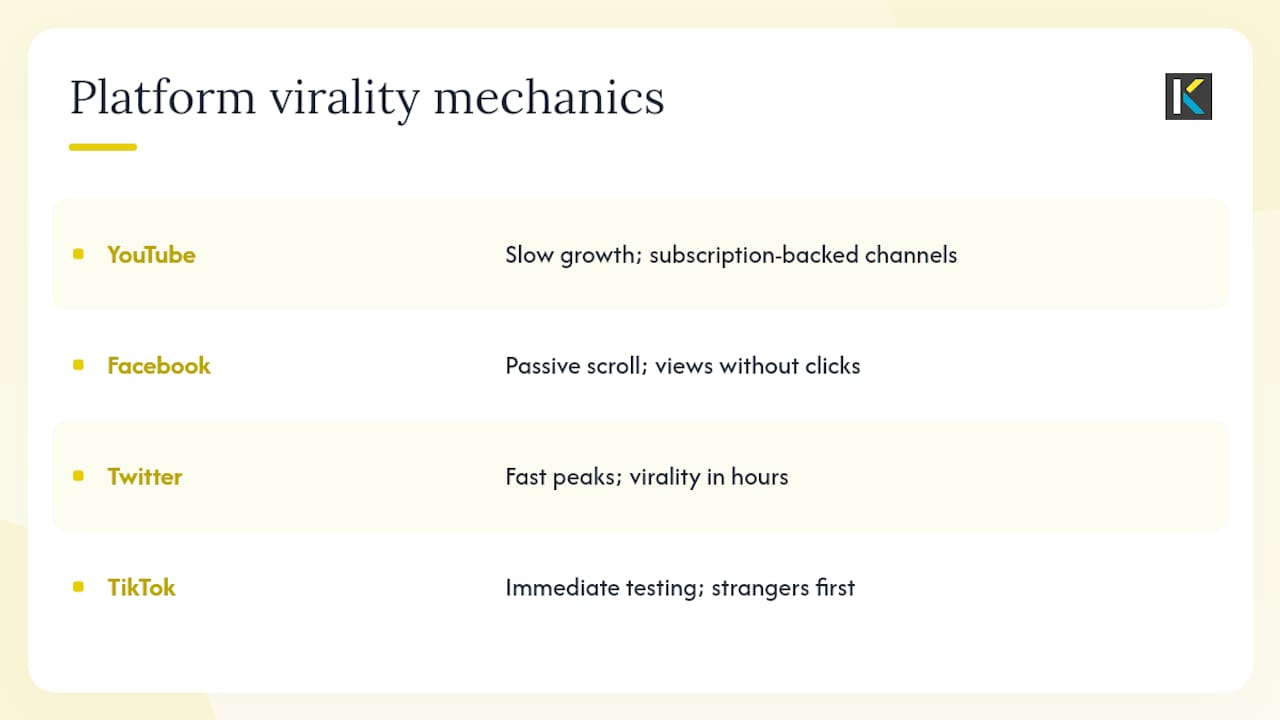
YouTube built the original playbook, but Twitter, Facebook, and later TikTok each changed the mechanics of spread. Facebook’s news feed turned embedded video into a passive scroll experience, meaning clips didn’t need a link click to rack up views, just a thumb that didn’t stop moving. Twitter compressed virality into hours instead of weeks, letting a clip peak and fade before most people even saw the original upload.
TikTok’s arrival changed the calculation completely. Its algorithm doesn’t wait for a video to build an audience through subscriptions or shares; it tests every upload against strangers immediately, which means a brand-new account can outperform an established one overnight. That’s a fundamentally different growth curve from YouTube’s, where the biggest videos tend to be backed by existing labels or channels with years of built-in audience.
The net effect is that “viral” now means something platform-specific. A clip trending on TikTok for 48 hours and a video sitting at 17 billion lifetime YouTube views are both, technically, viral successes. They’re just not comparable successes, and treating them as the same phenomenon is where a lot of casual “most viral videos” lists go wrong.
Case Studies: How These Specific Videos Actually Broke Through
“Gangnam Style” wasn’t a pure accident. PSY was already a known entertainer in South Korea, and the video’s absurdist “horse dance” gave English-language media outlets an easy, visual hook to cover it as a novelty story, which pulled in millions of viewers who had never heard Korean pop music before.
“See You Again” leaned on timing and emotional context rather than choreography. Released as the closing tribute in Furious 7 after Paul Walker’s death, the song’s meaning was inseparable from a real-world loss audiences already cared about, which drove years of repeat shares around the anniversary of his passing.
“Charlie Bit My Finger” had none of that machinery. It was a home video, uploaded with zero promotional intent, and it spread because early bloggers and forum users found it and passed it along, exactly the organic pattern that the Guardian’s retrospective points to as the model modern marketing teams have spent a decade trying to manufacture.
Comparing Virality Across YouTube, TikTok, and Facebook
YouTube rewards longevity. Its recommendation engine keeps surfacing older videos for years, which is exactly how “Baby Shark” and “Despacito” kept climbing long after their release windows closed. Views compound over a video’s entire lifetime, sometimes a decade or more.
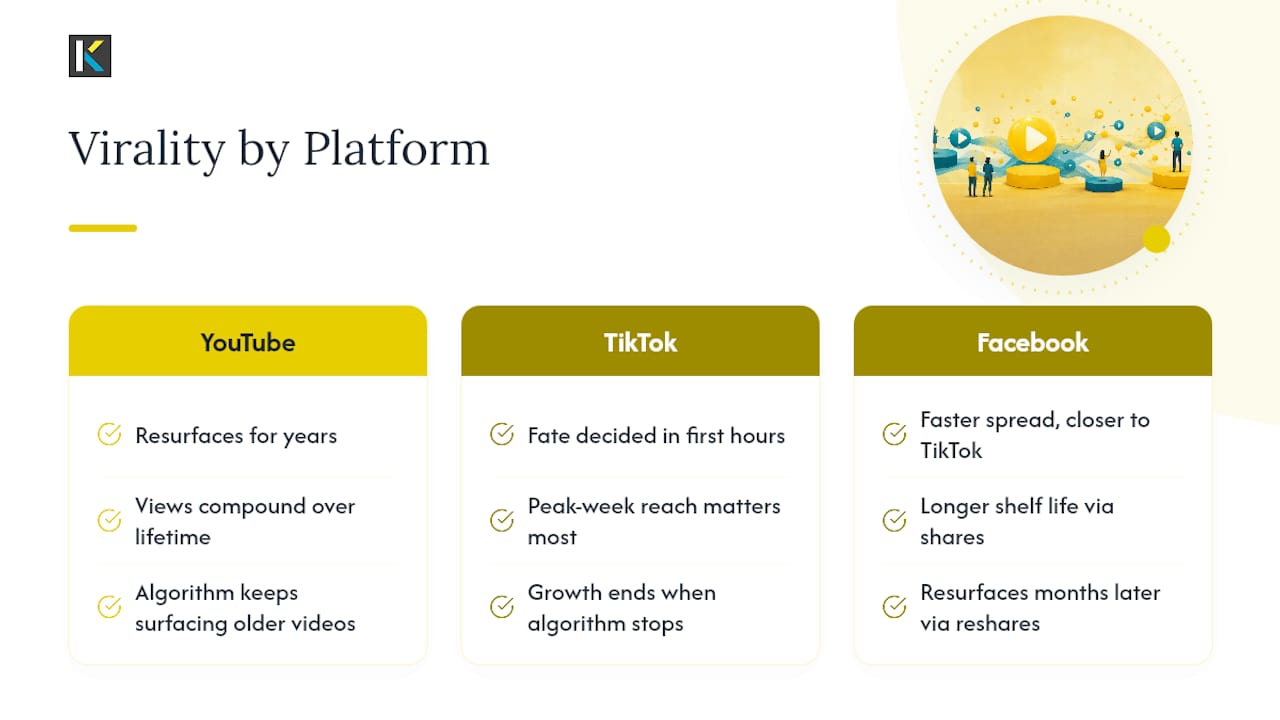
TikTok rewards immediacy instead. A video’s fate gets decided in its first few hours, and once the algorithm stops pushing it to new viewers, that clip’s growth effectively ends. Total lifetime views matter far less on TikTok than peak-week reach.
Facebook sits closer to TikTok’s speed but with a longer shelf life driven by shares within existing friend networks rather than algorithmic discovery. A video can resurface on Facebook months later simply because someone rediscovers it and reshares it to their circle, something TikTok’s feed structure makes much harder.
Why Culture and Region Shape What Goes Viral
“Gangnam Style” succeeded partly because Western audiences treated Korean pop as a novelty in 2012, a framing that would read very differently now that K-pop is mainstream globally. Baby Shark and Cocomelon, by contrast, work across nearly every language and region because their appeal doesn’t depend on lyrics landing as jokes or cultural references translating cleanly. A toddler in Brazil and a toddler in South Korea respond to the same tune the same way.
Regional platform habits matter too. Video content that dominates in one country’s social ecosystem can barely register in another simply because the dominant platform differs, and a clip built for one audience’s sense of humor or cultural reference points often needs local context to land anywhere else.
What Creators Should Actually Take From This
Chasing “most viral videos of all time” status is the wrong goal for almost every creator. What’s actually useful is understanding which lever you’re pulling: broad one-time reach, like a movie trailer, or deep repeat engagement, like a kids’ song. Trying to do both at once usually dilutes a video’s chances at either.
The tools matter less than the format decisions, but a smoother production process helps you actually finish and publish before a trend window closes. That’s the practical gap Kudoflix fills, letting creators produce a polished video without a steep technical learning curve so the bottleneck is the idea, not the software.
— Mandrixx
Sources
- List of most-viewed YouTube videos — Wikipedia
- Top 20 most viewed music videos on YouTube in 2026 — QZ
- Gangnam Style to Baby Shark: YouTube’s 20 greatest viral hits — The Guardian
Recommended